Field Observations – USSF 2007,
Bridgette Portman
UC-Irvine
“Government
as an Agent of Social and Economic Justice”
---
Organizer: Democratic Socialists of
Date:
Event Description: [From the USSF
website] This workshop will examine how progressives frame the issue of
government in their rhetoric about specific issues that involve an expanded
role for government and in their conception of the importance of a robust,
well-funded public sector. The workshop starts from the perspective that
corporations have so much economic and political power as a result of thirty
years of nearly uninterrupted right wing power that government must be re
organized so that it is not simply neutral but weighted toward working people,
unions, community based organizations etc. How do we advance the idea that
government must have as an explicit part of its mission countering the
destructive and disruptive effects of the so called “free market?”
Estimated # of attendees: 17
Composition of attendees (gender, age, ethnicity,
nationality, languages used, etc):
Attendees were polarized in age, with 7 individuals
appearing older than 50 years, 9 younger than 30 years, and
Describe Panelists (name, organizational affiliation,
union, country, etc):
Frank Llewellyn is a middle-aged white man from
Emahunn Campbell is a young black man from the
Will Emmons is a young white man from
Summarize speakers’ main points and any debates that
arose during the event.
Frank began the session by talking about the role of
government in achieving progressive change.
There is not a consensus among activists about whether government is
good or bad, and he hopes we can have a dialogue about it here. His opinion is that corporate power is an
“enormous elephant with its foot on the world” and is too strong for social
movements to combat without the help of state power, especially now that the
Emahunn spoke next.
He said that we cannot depend upon our current government, but must
organize and try to change it. He made
references to both Antonio Gramsci and Martin Luther King, both of whom knew
they had to change the status quo. He
also said that more black people need to be involved, but that they have seen
government fail to keep its promises to them and this has generated skepticism among
them about the role of government.
Will spoke of the need for a society where everyone
can develop to his or her full potential -- this is his definition of
socialism. However, “history has proven”
that the old socialist theories of central planning and a state-run economy are
not good; instead, we need to use government to regulate the market. Although anarchists disagree and think the
state is always bad, Will argues that the state can be a force for good. It is a mechanism of class oppression but it
can be used to “repress” bourgeois forces.
There is also a danger in propagating a paternalist view of the state as
something that simply gives us what we need -- it is necessary to find ways to
use the state to empower people. He
mentioned the example of having the government give tax credit to worker-owned
businesses.
Question/Discussion Time:
After the panelists’ presentation, the session was
opened up for discussion. An older white
man asked how we can talk to people about government as a positive force when
so many people are cynical and distrustful of it. A woman agreed that this is difficult, and
suggested that perhaps we might only get through to people when economic
inequality becomes greater. She said
that although she was influenced herself by anarchist thought, she believes
that some kind of representational system is necessary. A young man suggested giving examples to
people of situations in which the government can help them, such as providing universal
healthcare (an example repeatedly brought up) and grants and loans for
tuition. The woman controlling the video
camera gave the example of farmers’ markets on city-owned land, as well as
railroads in
An older white woman admitted feeling “fairly
frustrated” about the pace of change, and asked the young man from
A slight controversy came up when one man argued that
we should heed Engels and be careful not to reify the state. This also generated a brief discussion about
what the world “reify” meant, for the sake of the people who might watch the
recorded session online. The man who brought
it up said that he meant we should not make the state into something godlike
and beyond human beings. He argued that
we should not forget the importance of the people in the movement, who will
need to organize and help themselves. He
also argued that we need an analysis of class that includes more than just
workers and capitalists, as there are many other economic gradations.
Several young people commented about how government
can help students. A young white man
from
Another issue brought up was military spending. Frank argued that we need to cut back on the
military budget in order to increase funding for social programs. When these programs lack the necessary
funding, they are perceived to have failed, further reducing people’s
confidence in the government.
Corporations also profit off of war spending.
Were plans for specific actions or future campaigns
discussed?
In the beginning of the session, Frank introduced the
initial draft of a document, “Toward an Economic Justice Agenda,” that is a
project of DSA. According to the
document, “Our hope is that this project can lead to a consensual economic
justice program that a broad coalition of left and progressive groups will
eventually coalesce behind.” This is
still an evolving document, and Frank invited us to give our comments and
feedback on it. The specific goals
listed in the Agenda include a single-payer national health insurance system,
increased funding for education, and stronger rights for workers in the
workplace.
Were any cross-movement or transnational networks or
coalitions discussed?
They were not directly discussed; however, one man
suggested to the Venezuelan attendee that DSA should invite a group of
Venezuelan workers here to the
Describe any evidence of networking you see among
attendees.
No contact sheet was passed around, but in the
beginning of the session all of the attendees took turns briefly introducing
themselves, giving their names and group affiliations. Frank then urged us to give out fliers to
people at other sessions, and told us about DSA’s staffed table, and about
DSA’s publication, “Democratic Left,” which has a special issue about the
Social Forum. He also encouraged those
who were not members of DSA or YDS to join up, and told us about a party
planned for Saturday night. In addition,
there was a list on the table of all the events in which DSA was participating
or organizing at the Social Forum.
THEMATIC ISSUES:
There was no discussion of the USSF/WSF process
itself. The focus was on reformist
change in that although the panelists and participants had an explicitly
socialist and anti-capitalist perspective, they did not advocate achieving that
change through revolution, and they seemed to envision socialism as a kind of
market arrangement in which the state would act as regulator to restrict
corporate power. Indeed, it was
difficult to see how this vision differed from a stronger version of welfare-state
capitalism. They saw a positive role for
government, while acknowledging that the current government, including the
Democratic Party, is not progressive enough, and that any use of state power
must rest upon a foundation of social movement organizing. There was no real discussion of international
institutions or organizations, although the Economic Justice Agenda document
does contain a section about this. One
woman did mention that she thought the
Although 6 of the attendees were from the
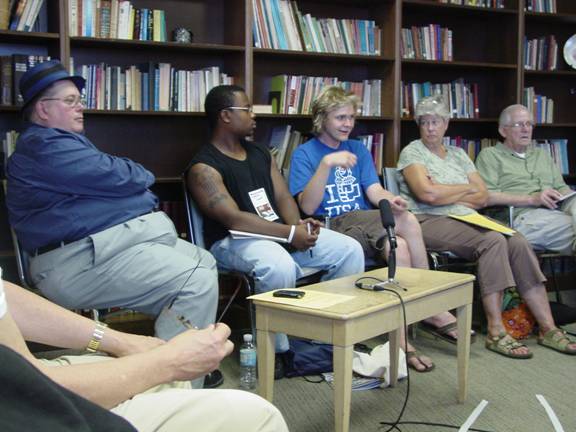
Frank Llewellyn (left),
Emahunn Campbell, and Will Emmons (speaking)
“The
US
---
Organizer: Solidarity
Date:
Event Description: [From the USSF
website] SOLIDARITY will serve as the lead organization for a panel and
discussion (two-hour session) to include representatives from publications and
organizations that have longstanding involvements in the U.S. working class
movement -- broadly defined to include trade union movements but also rank and
file organizing, workers centers and social movements around issues that affect
working people. Panelists will include representatives of the publications
AGAINST THE CURRENT, the magazine sponsored by Solidarity; INTERNATIONAL
SOCIALIST REVIEW, published by the International Socialist Organization; and
DEMOCRATIC LEFT, published by Democratic Socialists of America. (Other
magazines are being solicited for participation, with responses pending at the
time of submission.) Initial presentations will be structured to take no more
than 40-45 minutes in total (divided equally among the panelists) to be
followed by a brief follow-up exchange and then contributions from the floor.
Speakers in the discussion period will be limited to three minutes to ensure
maximum participation. The chair will have discretion and be positively
encouraged to give priority to women, youth and peopled of color in calling on
participants in the discussion. Panelists will have brief wrap-up statements.
This panel will represent a diversity of views and strategic perspectives on
important questions, while sharing a common view that rebuilding a class
movement in this country -- a movement that embraces the liberation of women
and oppressed people and resists imperialist wars, as well as fighting for
economic justice -- is central to defeating the right wing and breaking the
stranglehold of reaction on politics in this country. The presentations will
take this framework as the starting point for an exchange of ideas on the
openings and the obstacles to this effort.
Estimated # of attendees: 27
Composition of attendees (gender, age, ethnicity,
nationality, languages used, etc):
About 9 of the attendees appeared to be older than 50
and 6 younger than 30, with the rest in the 30-50 range. Two thirds (18) of the
individuals were male and one third were female. The attendees were
overwhelmingly white, with the exception of 2 women who appeared to be of
possible Latino origin. One young man was Swedish while the rest of the
individuals were from the
Describe Panelists (name, organizational affiliation,
union, country, etc):
Dianne Feeley is a white woman appearing to be in her
60’s; she is on the editorial board of Against the Current.
Milt Tambor is a white man in his 50’s or 60’s; he is
chair of Atlanta DSA. He also attended the
Ashley Smith is a middle-aged white man on the
editorial board of the International Socialist Review.
Summarize speakers’ main points and any debates that
arose during the event.
Dianne started out with some brief comments about the
potential power of the working class in the
Milt, who has spent 30 years in the labor movement,
discussed neoliberalism and its results -- the weakening of unions and the
public sector, the increase of the power of global corporations, the
undermining of the values of liberty, equality and fraternity, the mantra that
there can be no alternative to a market economy. He gave out some statistics about the
deteriorating condition of the working class in the
Ashley explained how 9/11 resulted in a rollback of
the “radicalization” of the working class that had been in progress in the late
1990’s. The Bush administration, “with
the willing cooperation of the Democratic Party,” took advantage of the
aftermath of 9/11 to put reactionary pro-corporate measures into effect. Since then, an international resistance to
the
Dianne spoke forcefully about some of the challenges
still faced by the left: Workers have misconceptions about their rights, and
“there’s not one voice in Congress” willing to help workers against the power
of corporations. Even unions are not
much help, as they are too willing to make concessions and are not democratic
enough. Corporations use a strategy of
“management by stress,” pitting workers against one another to keep them from
uniting. We need to focus on the issues
that unite people in order to build a new, stronger movement.
Discussion/Question Time:
One debate that came up concerned the attitude of
activists toward the Democratic Party and toward unions. One woman complained about the lack of a
party or candidate that really represents the working class, and thought that a
third party is needed. She also thought
that the leadership of the labor movement might need to be altogether
replaced. Another woman claimed, “In no
way will I lift a finger to help the Democratic Party” and criticized the
AFL-CIO for not being close enough to rank-and-file workers. Milt, however, contended that it is important
to work within the Democratic Party, not as an exclusive strategy, but as one
tactic. He also to some extent defended
unions, pointing out that they are sometimes put in difficult situations that
require compromises. Ashley did not
think that the Democratic Party could ever be a workers’ party because it is
too tied to corporations, but said that many of the people who support it do so
for the right reasons and that we need to be patient with them.
Another interesting debate centered around the use of
the term “socialism.” An older woman
wondered whether it is to use that term when people have so many misconceptions
about it. “Don’t say it,” one woman
responded. She thought that the working
class is not radical enough to hear about socialism yet, and that activists
should focus on concrete issues instead of getting “hung up” on the idea of
socialism. Another woman disagreed,
arguing that people are interested in knowing what socialism means. Later in the discussion a man expressed the
same idea, arguing that it is important to connect specific issues to a larger
vision. He thought that the leftist
movements in the 1960’s and 1970’s failed for just this reason -- they had no
vision beyond specific issues to keep them together.
Were plans for specific actions or future campaigns
discussed?
Milt, who had also been present at the DSA meeting
earlier today, brought up the four pillars of the Economic Justice Agenda,
listed above. This was probably the
closest thing to a specific campaign that was discussed.
Were any cross-movement or transnational networks or
coalitions discussed?
No official coalitions were discussed, but other
movements did enter the conversation.
Ashley, who has worked with Iraqi Veterans Against the War, mentioned
the
Describe any evidence of networking you see among
attendees.
No contact sheet was passed around, but in the
beginning participants briefly introduced themselves, giving their names and
organizational affiliations. There was
informational material provided and Milt invited us to share it with others to
help educate people. He also told us
about an upcoming party hosted by Jobs for Justice. In addition, Dianne made an announcement about
a group of Iraqi trade unionists at the USSF and encouraged us to hear them
speak.
THEMATIC ISSUES:
A middle-aged man complained that most people at the
Social Forum are not connected with the labor movement. The demographics of the people in this room
(mostly white and middle-aged) do not reflect those of the rest of the Social
Forum, which is largely young people and people of color. He wondered how we can make this discussion
relevant to their experiences. A young
man responded by saying that he had been to a workshop on minority unions, and
the demographics there were very different, very young and diverse, but he
agreed that socialists have not yet made their ideas relevant enough to a lot
of people. Other than this comment, the
USSF/WSF was not discussed.
The goals of this group seemed to be somewhat radical,
in that they expressed a definite socialist, anti-capitalist, anti-neoliberal
perspective, but there was no discussion of radical means to achieve it, and
the change they seemed to be looking forward to was a gradual one. When one man asked how we can build a
revolutionary workers party, Ashley responded by urging patience, not to expect
too much too fast, and that workers cannot become revolutionaries overnight.
As described above, participants had mixed views about
the usefulness of the Democratic Party and trade unions under their current
leadership. Dianne stressed the need to
make unions more democratic.
International organizations or institutions were not discussed, other
than Milt’s mention of the need to reform NAFTA so that it includes labor and
environmental protections.
For
the most part, the issue was framed as a national one -- the struggle between
labor and capital in the
“The Struggle of Workers in the Rust Belt”
---
Date:
Event Description: [from USSF website] A workshop on "The Struggle of Rust Belt Workers"
will address the devastating effects of
Estimated # of attendees: 24
Composition of attendees (gender, age,
ethnicity, nationality, languages used, etc):
A majority of the attendees were middle aged; 5 or 6
appeared to be in their 50’s, 8 younger than 30, and the rest in the 30-50
range. None appeared to be older than
60. About 13 of the attendees were
white, 4 were black, 4 were Latino, and 1 was Asian. Roughly one third (9) of the individuals were
female. English was the only spoken
language used, although fliers were available in both English and Spanish.
Describe Panelists (name, organizational
affiliation, union, country, etc):
Noel Beasley is the International Vice President of
UNITE HERE. He is a middle-aged white
man from
Kathy Hanshew is a white woman appearing to be in her
30’s. She is currently a union
representative in
Jacquie Chapman is a middle-aged black woman who has
also worked in the auto parts industry. She is currently a member of a local in
Kenny Harrison is a middle-aged black man involved in
organizing workers in the Redcats garment industry. He is president of a local in
George Long is a middle-aged black man; he is
president of a local in
Margarito Diaz is a young Latino man involved in
organizing workers of 5-Star laundry in
Paula Lenchan is a middle-aged white woman; she is
president of a local that organizes casino workers in
Summarize speakers’ main points and any debates that
arose during the event. Include discussions of problems facing workers,
strategies for social change, etc.
Noel Beasley began the event by introducing UNITE
HERE, an affiliation of unions that represents both industrial workers and
workers in the service industry -- including laundry, food service, hotel and
casino workers. Many of their members
have moved back and forth between the two sectors. He stated that they came to the USSF to exchange
ideas about the problems facing workers in both of these sectors in the “Rust
Belt” (the upper
Kathy Hanshew spoke about her experiences organizing
workers in an
Jacquie Chapman also worked in auto parts
manufacturing; she described her work for Ford Motor Company starting in the
late 1970s. She described layoffs in the
1980s as Ford contracted to cheaper labor overseas. She claimed that now workers in this industry
are even worse off; she lamented that workers today make less than what they
earned in the 1980s and that layoffs and plant closings in the auto industry
have affected the whole region. Part of
the problem facing unions is that many workers don’t understand the benefits
that unions can bring, even those that are members, and are afraid of the
repercussions of speaking out. “They
don’t want to lose what they have, but they don’t want to fight for what they could
have.”
Kenny Harrison was part of an effort around 5-7 years
ago to organize workers in an
In introducing the next speaker, Noel discussed how
UNITE HERE has made efforts to unify the significant immigrant workforce in the
upper
Margarito Diaz spoke about the problems facing workers
for the 5-Star laundry company in urban
The final speaker, Paula Lenchan, spoke briefly about
workers in Ceasar’s Casino in
Noel concluded the panelist portion of the session by
reiterating that workers in the upper
Question/Discussion Period:
A number of questions were taken from the audience in
the second half of the session. Noel was
the main panelist to answer, but sometimes the others joined in.
Much of the questions and discussion focused on UNITE
HERE’s training programs for workplace leaders.
Noel described their “3 ½ Day” schools that use documentaries and guest
speakers to educate workplace leaders from a wide geographical range. They offer four or five of these schools per
year, each training 20 to 25 workplace leaders.
A Latino man and woman who were involved with these schools elaborated
on them. These schools are also
conducted in Spanish for immigrant workers.
Many workers that come from
While Noel was positive about these training programs,
he was critical of traditional union meetings, which he said are really only
perfunctory. Workers don’t want to come to them. The best way to really meet
with workers is in the workplace itself.
The Latino man who spoke earlier about the training
program argued that we need to have a debate about the future of work in
Another topic that arose was how to go about educating
average workers about what unions can do for them. Jacquie replied that we need to talk to
people one-on-one and inform them of the positive things about unions, to
counter negative preconceptions, e.g. “they only take our dues.” Noel added that the use of video and DVD as
educational tools has been very successful.
Workers can be shown films during their lunch breaks or given DVDs to
take home.
Were plans for actions or future campaigns discussed?
Several specific campaigns were mentioned. Just before the panelists opened up the
session to questions, a representative from
Also, during the question/discussion period a young
man passed around a petition to “Repeal the Carolina Bargaining Ban.” A
Were any cross-movement or transnational networks or
coalitions discussed?
There was no discussion of cross-movement
networks. Although the struggle for
immigrant rights was a theme, this was framed in terms of a challenge for the
labor movement. The only discussion of
transnational networks emerged in the context of the international struggle
against the France-based garment company, which involved European trade unions,
particularly French, in addition to Kenny’s union. At another point, Noel mentioned sometimes
bringing Columbian trade union leaders to his meetings, which helped put
current struggles in perspective for American workers. In
Did you notice any networking happening among
attendees?
I did not notice any networking in terms of exchanging
personal information, other than the petition that was passed around and the
pledge cards for the “American Vulture” boycott. One woman also spoke up and advertised a
documentary about workers and globalization that her group was distributing,
and provided a web address where it could be found.
THEMATIC ISSUES:
There was very little discussion of the USSF/WSF
process itself. In the beginning, Noel
stated that UNITE HERE came to the USSF to exchange ideas. However, near the end he also said that -- at
least regarding the issue of resources for returning war veterans, one topic
that came up -- we need to start coming to some conclusions at these forums and
are at the point where we need to develop a practical program. He did not elaborate on this.
The session emphasized reformist goals -- although
globalization and neoliberal trade laws were identified as the key causes of
job loss, no one expressed explicitly anti-capitalist attitudes.
The role of government was not a major theme in this
session. When it did come up, it was
presented as at best a possible tool to help workers, and at worst part of the
problem. Noel was critical of the Bush
administration’s lack of accountability and expressed regret that Congress was
unable to pass its latest attempt at an immigration reform bill. While Noel did not support the legislation
itself, he thought that it was good that Congress was discussing the
issue. He also mentioned that the
struggle for universal healthcare is currently his union’s main political
fight. Overall, the attitude toward
politics expressed here seemed to be one of engagement, but without
illusions. The only international
institution mentioned was the ILO, in the context of the petition against
All of the participants seemed to identity strongly
with the labor movement and there was no clear evidence of identification with
other social movements, a global left, or the WSF process itself. This session focused explicitly on the upper
Midwest and issues were generally framed as regional concerns, although there
was an attempt to connect them to nationwide problems -- for example, the
declining strength of unions in the
“There
is an Alternative: Economic Democracy”
---
Organizer: SolidarityEconomy.net
Date:
Event Description: [From the USSF
website] Another world is possible?
We keep repeating these words, but what exactly would that world look
like? More specifically, what might be
its underlying economic structure? Since
the Reagan/Thatcher days, TINA has been the mantra: there is no viable
alternative (to capitalism.) In Thomas Friedman’s words, “There’s only free
market capitalism or
Estimated # of attendees: 100
Composition of attendees (gender, age, ethnicity,
nationality, languages used, etc):
This was a popular workshop among young people; as
high as 60-70% of the attendees appeared to be under the age of 30. The number of males and females was roughly
equal. The large majority were white; nonwhite attendees comprised roughly 15%
and included black and Latino individuals. One young woman videotaped the event. The workshop was conducted in English, but a
Spanish interpreter was provided for one (or perhaps several) Latino
individuals on the far side of the room from where I was sitting.
Describe Panelists (name, organizational affiliation,
union, country, etc):
David Schweickart is a middle-aged white man and
author of several books, including After Capitalism. He is a philosophy professor at
Michael Albert is a middle-aged white man and has also
written several books, including Parecon: Life After Capitalism. He is founder of Znet and co-founder of Z
Magazine.
Carl Davidson, one of the editors of
SolidarityEconomy.net, was the moderator of this session.
Summarize speakers’ main points and any debates that
arose during the event.
This was a highly structured workshop: The two
panelists gave their arguments and then several questions were taken from the
audience. Carl Davidson began by
introducing the session and the two speakers.
The first to speak was David Schweickart. David started out by stating that he and
Michael Albert agree on several things: Capitalism is flawed and must be
replaced; Soviet-style centralized planning is not the answer; participatory
democracy is a must. They disagree,
however, in their attitudes toward the market.
While Michael thinks that all markets must be abolished, David thinks
that a competitive market for goods and services is okay -- it is only the
capital and labor markets that are destructive.
In his proposed system of “economic democracy,” firms would be democratically
run through worker councils that appoint the management, but these firms would
still be able to compete in a market. In
addition, there would be a flat tax on all enterprises that would be invested
back into the economy, generating “social control of investment.” According to David, this sort of system would
abolish the destructive aspects of a market system while preserving its good
elements, creating “a democratic order genuinely responsive to human needs.” Other elements of this system include a
living wage and guarantee of full employment, a permitted small business
sector, and “socialist protectionism” that shields workers from competition
from cheap labor overseas -- with the caveat that proceeds from tariffs should
go back to those poorer countries. David
believes that this system could come into effect easily, perhaps initiated by a
progressive political party. Of
Michael’s vision of the future, David calls it “obsessively egalitarian” and
nonviable, and claims that it ignores the problems with information and
incentives that will occur in the absence of a market system.
Michael spoke next, introducing his vision of “parecon,”
or participatory economics. It is
imperative, according to Michael, to create a classless society where people will
not have opposing interests, and in which people do not have the incentive to
be selfish. He calls himself a “market
abolitionist” and is certain that in 50 or 100 years people looking back on the
present day will see markets as highly destructive. Instead of markets, he foresees a form of
planning in which worker and consumer councils will cooperatively decide what
needs to be produced. This is not
centralized planning but a democratic, cooperative process. This would avoid the adversity between buyers
and sellers that is inherent in market systems, and ensure that goods are
allocated not on the basis of happenstance or inborn skills and talents, but
according to how much and how hard people work.
It would also avoid the harmful effects, such as environmental damage,
that come with making decisions on the basis of profit.
Question and Answer Period:
The last 40 minutes of the session were devoted to
questions from the audience. This was
also very structured. Many people raised
their hands with questions, and Carl chose nine who went up to the microphone
in turn and directed their questions to one or both of the panelists.
One of the subjects that came up was the process of
economic planning. One man talked
(rather at length) about Mao’s approach to planning and argued that there does
need to be some form of centralized planning, in order to ensure that society
is moving toward certain overarching goals.
He asked the panelists to respond to this -- what would be the
relationship between planning on a local level and planning at a more central
level? Michael’s answer was that better
results are achieved when planning is done in a democratic and participatory
way, because it is the people themselves who know their preferences and what is
best to produce.
Several questions dealt with the transition from the
current system to the new one. One man
said “I hate to sound like a Marxist, but…” and asked about what sort of crisis
could serve as a trigger for bringing this new system into existence. Michael’s response was that we do not need
the transition to be a “crisis” -- we would be more likely to end up with
fascism than anything else if that happened.
Both he and David agreed that the transition should be a gradual
one. People cannot become radicalized
overnight, but must be gradually persuaded of the advantages of an alternative
society.
Another topic that came up was education. After a woman asked about changing the
university system, David remarked that it needs to be made more democratic. Michael said that the university system as it
now exists trains 80 percent of its graduates to be obedient workers who do not
participate in making decisions -- and this needs to change.
Finally, one young woman challenged Michael by
describing what she felt was an example of a successful market system, one
created by a Buddhist movement in
Were plans for specific actions or future campaigns
discussed?
The closest to this came when David mentioned some
specific reforms that should be fought for as a starting point. These included more worker cooperatives, a
capital asset tax on corporations, more job security in capitalist firms, and
fair trade policies.
Were any cross-movement or transnational networks or
coalitions discussed?
David and Michael both agreed that numerous leftist
social movements needed to be involved in the transition to a new society. In response to one woman’s question, David
said that structuring the economy in a new way would not be enough to ensure a
just society -- the actions of groups like environmentalists and anti-racists
will be crucial as well. Michael said
that a leftist alliance should be formed, encompassing feminist,
environmentalist, cultural, and other movements. In this alliance, each component should
recognize the importance of the others and realize that their own victory
depends on the victory of all.
Describe any evidence of networking you see among
attendees.
A contact sheet was passed around the large
audience. In the beginning, Carl invited
us to visit SolidarityEconomy’s tent, and to pick up a brochure that had
information about theirs and other related workshops.
THEMATIC ISSUES:
The Social Forum itself was not discussed.
Both of the panelists seemed to be moderately radical,
judging by their visions of a new society; Michael’s was undoubtedly the more
radical, as he called for the abolition of markets altogether. At one point Michael talked specifically
about the idea of reform; he said that reforms are not bad things, because they
make people’s lives better. “If the left is critical of or rejects reform it
means we’re callous and uncaring in the short term.” However, he said that we are not simply
“reformists.” We want more than that.
The role of government was not extensively
discussed. David did mention that he
thought a leftist-leaning government could help initiate the transition toward
his new society, and Michael’s comments about reforms suggest that he probably
agrees with this. However, Michael had
some closing comments that were highly critical of government -- or at least
its current leaders. He said that
politicians lie about their objectives and do not follow through with their
promises, even liberals like Clinton and Obama.
According to Michael, “the most rational [people] are the ones who don’t
vote.”
One woman asked specifically about the scale on which
these new models of society should operate.
Michael said that his model works best on a large scale -- the
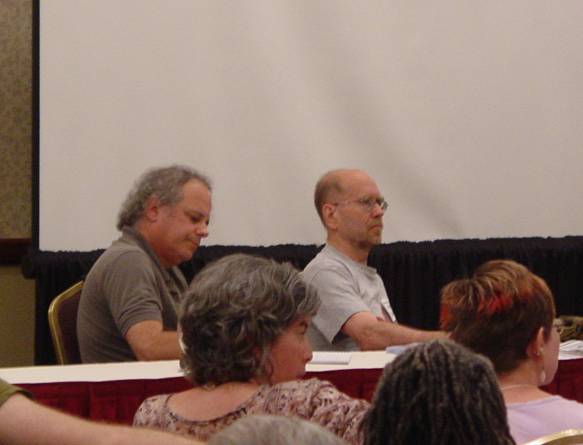
Michael Albert (left) and
David Schweickart
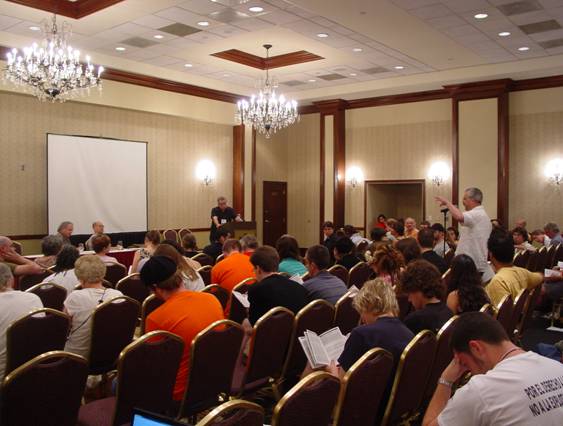
SolidarityEconomy.net
workshop: An audience member asks a
question as the panelists listen and Carl (at podium) moderates
“Envisioning
Socialism in the 21st Century”
---
Organizer: Committees of Correspondence
for Democracy and Socialism (CCDS)
Date:
Event Description: [From the USSF
website] Our organization's strategy is
to build and organize a progressive majority, which would be the broadest
possible coalition of progressive forces united around a minimum common
program. It would be a coalition of left
and center, capable of defeating the right wing and launching the country on a
path to peace, justice, and equality.
Our members are impelled by a vision of a socialist world, free of
exploitation. We should like to share
our vision with the participants in this session. Each presentation in the panel will be
participatory.
Estimated # of attendees: 36
Composition of attendees (gender, age, ethnicity,
nationality, languages used, etc):
There were 16 women and 20 men in attendance. The majority of the individuals were white,
with 7 black and 2 or 3 Asian individuals.
14 of the attendees were younger than 30, 4 appeared to be in their 60’s
or older, and the rest appeared to be in the 30-60 age range. The workshop was conducted in English.
Describe Panelists (name, organizational affiliation,
union, country, etc):
Ira Grupper is a white man who appears to be in his
60s. He is a retired factory worker from
Carl Bloice is a middle-aged black man from
Mildred Williamson is a middle-aged black woman. She is a social worker and activist from
Jim Campbell is a middle-aged black man. He is an educator who has worked in the
Northeastern USA as well as in
Bill Chandler is a white man probably in his 60s. He is Executive Director of the Mississippi
Immigrants Rights Alliance (MIRA).
Summarize speakers’ main points and any debates that
arose during the event.
Ira introduced the session and CCDS. Although neither he nor the other panelists
envision full socialism in the 21st Century, he thinks that
socialism “remains a powerful vision for much of humanity.” In this session he wants to have a discussion
about how it relates to concrete issues.
Carl spoke about the global divide between the rich
and poor, using the metaphor of “Richestan,” where rich people live, versus
everyone else. Globalization has created
this gulf. Although some people argue
that it is inequality that fuels progress, this is false and we need a new
economic system. All workers should have
economic stability, housing, and education.
He gave some statistics on poverty and inequality in the
Mildred spoke next, focusing on healthcare. She made the disclaimer that a good
healthcare system does not necessarily require socialism -- it is
something we can fight for right now.
She framed healthcare as a human right.
It is part of a social safety net, including Medicaid and Medicare, that
has eroded in the
Jim spoke about education. He said that the world is now experiencing a
“second globalization,” the first being the slave trade, in which human beings
were commoditized. Today, government
officials and corporations are having a negative impact on education. There is an attack on the idea of education
as a public good, with pushes to privatize schools. The idea is propagated that schools must
prepare students to meet the needs of the global economy, rather than to be
participants in a democratic society.
Schools are beginning to use the language of the market, speaking of
students as “consumers.” Some schools
are financially supported by businesses.
Jim argued that we should push for education as a civil and human right. He described a group, the Young People’s
Project, that is involved in the fight for quality education in
Bill spoke about immigrant rights. He argued that it is unjust that capital can
move freely across national boundaries, while workers cannot. He argued that immigration laws in the
Question/Discussion Time:
There were about 30 minutes devoted to
discussion. Michael Kaufman, the West
Coast Regional Coordinator for CCDS, made an interesting comment at the
beginning of the discussion period. He
said that even though some people might have come to this workshop expecting to
hear about a vision of socialism, CCDS “is not interested in utopian blueprints
about what might happen in the future.”
Instead, they want to focus on “the road to be taken to get there” and
on the current issues people are fighting for.
This reminded me of the debate in one of the workshops yesterday about
whether socialists should talk about long-term visions or stick to concrete
issues.
One of the people in attendance was Carl Davidson, who
had been moderator in the SolidarityEconomy workshop (see previous
report). He described his effort to
build a “high-tech high school” in
Another question to Jim came from a black woman from
The other main topic that came up was
immigration. One man thought it was
ironic that the
Were plans for specific actions or future campaigns
discussed?
Most of the discussion was about more general goals
rather than specific campaigns.
Were any cross-movement or transnational networks or
coalitions discussed?
Bill mentioned the importance of international
organizing. He also said that the
Mississippi Legislative Black Caucus has been a strong supporter of his group
MIRA’s efforts to defeat anti-immigrant legislation. As more Latinos come into
Describe any evidence of networking you see among
attendees.
A contact sheet for a mailing list was passed around
in the beginning of the session. The
panelists urged us to take the literature provided on the table. Ira told us about CCDS’s “educational
modules,” or study groups, and encouraged anyone interested in starting a local
one to talk to him after the workshop.
THEMATIC ISSUES:
Carl Bloice complained that the media is not paying
sufficient attention to the Social Forum.
He thinks this was a political decision, not a journalistic one. Leaders of this country are afraid that
another world is possible. Apart from
this comment, the USSF/WSF was not directly discussed.
Anti-globalization and anti-capitalism were strong
themes. One man asked specifically about
CCDS and its position on whether socialism will come about through reform or
through revolution. Carl Davidson said
that they are a “pluralist organization” and have people on both sides of the
debate. Carl Bloice said that it is not
possible to state a position of CCDS on this, but he believes that in the
advanced capitalist countries, socialism will come about through elections and
building political power. This, combined
with his comments about socialist parties in
The discussion focused on the
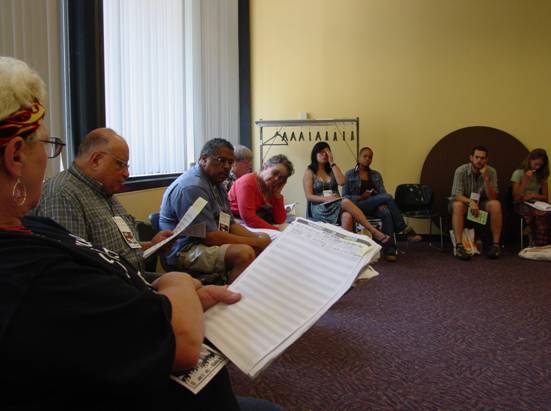
Ira (left, checkered shirt)
speaks at the CCDS workshop
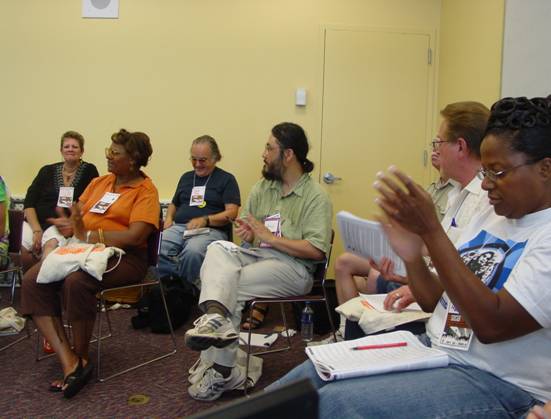
Audience members applaud at
the CCDS workshop
“Domestic/Household
Workers Organizing in the US
---
Date:
Event Description: [From the USSF
website] This session will be a multi-media, collaborative presentation of
domestic workers organizing across the
Estimated # of attendees: 100
Composition of attendees (gender, age, ethnicity,
nationality, languages used, etc):
Most of the attendees were nonwhite, mostly Latino
with some black individuals, including a group of 15-20 young African Americans
wearing orange T-shirts advertising “Worker Memorial Day.” A large majority were women. There were a large number of young attendees
-- it looked as though at least half of the audience was under 30 -- including
several young children who played in the back of the room. This was a bilingual presentation – some of
the panelists spoke English and some spoke Spanish. Headsets with earphones were available for
attendees who were not bilingual. When
the headsets were turned on, attendees could hear an interpreter translate the
panelists’ words.
Describe Panelists (name, organizational affiliation,
union, country, etc):
The panelists were all women, mostly
Summarize speakers’ main points and any debates that
arose during the event. Include discussions of problems facing workers,
strategies for social change, etc.
This was a very lively session with the atmosphere of
a rally; audience members often clapped and cheered for the speakers, and
several times broke out into chants of “ain‘t no power like the power of the
people” and “si se puede!” It seemed
like the attendees came to the session as much to encourage one another to
continue their struggle as to exchange ideas.
Jocelyn, a
The next speaker, Alexis, from the Committee of Women
Seeking Justice, discussed how the USSF not only allows domestic workers to
stand up and be counted, but also to meet each other and learn about organizing
taking place in other areas of the country, and talk together about what needs
to be done in the future. She listed the
names of all of the organizations represented at the workshop, punctuated by
applause from the audience.
During the remainder of the workshop, panelists gave
short presentations on the work being done by their organizations. Panelists were grouped regionally, beginning
with
The panelists from
The presenters from Los Angeles included a woman who
argued for the use of the term “home workers” rather than domestic workers
because the former is a broader term; many people do not realize how much these
workers do in addition to things like simply cleaning houses. They are often cooks, nannies, gardeners, or
companions to elderly people. A
representative from the
The final presentation came from Alexis, who spoke
about the Committee of Women Seeking Justice, a group organizing domestic
workers in
Following a song performed by four of the women, there
were several questions/comments taken from the audience. One woman brought up the immigration reform
debate in Congress and the proposed guest worker program. Alexis said that we need to make sure guest
workers have same rights and protections as any other worker -- and that they
will not be afraid to stand up for their rights for fear of losing their
visas. Several other panelists also
commented on this topic and were critical of the guest worker proposal.
Were plans for specific actions or future campaigns
discussed?
This session seemed focused more on educating one
another about past and ongoing campaigns than about planning future ones. One of the more specific campaigns mentioned
was the Domestic Workers Bill of Rights, advocated by the Committee of Women
Seeking Justice. Alexis also mentioned
that tomorrow the groups involved in the National Domestic Worker Convention
(see below) will meet to talk about how to collectively work together and move
forward.
Were any cross-movement or transnational networks or
coalitions discussed?
Most of the coalitions discussed were those among the
domestic worker organizations themselves.
For instance, all of the groups represented in the session today are
part of a larger meeting, the National Domestic Worker Convention, that
gathered at the USSF to share experiences and ideas. Although these groups largely represent
immigrants, there was little discussion of transnational networks or
organizations in other countries. An
exception was the representative from Damayan, who stressed the importance of
connecting issues facing domestic workers in the United States to issues back
home (Philippines). Damayan is involved
in supporting the movement for democracy in the
Did you notice any networking happening among
attendees?
There was a lot of talking going on in the audience
throughout the event, especially in the back of the room. It is possible that people were exchanging
information informally, although I was not able to catch anything specific. A contact sheet was passed around with spaces
for name, organization, email, and phone number. There were also a large number of fliers and
pamphlets on a side table in the room, providing information about the groups
for anyone interested. One panelist from
Domestic Workers United urged everyone to bring these materials to their
communities, worker centers, and churches to educate people.
THEMATIC ISSUES:
There was little discussion of the USSF/WSF
process. Alexis stated at the beginning
that the USSF was a good opportunity for domestic worker groups to make
themselves heard, share ideas, and learn about the work being done around the
country by similar groups. The
rally-type atmosphere in the workshop leads me to believe that a key part of
why these groups came to the USSF was to gain encouragement and inspiration from
one another’s stories of struggle and success.
The demands of the groups did not sound radical --
although there was discussion of globalization and neoliberalism as a root
cause of immigration and workers’ problems, there were no explicitly
anti-capitalist views presented. For the
most part, the issue was framed as one affecting domestic workers in the
The role of government was mentioned mainly in the
context of bills submitted to state or local governments; the groups seemed to
think that government could potentially play a positive role in protecting
domestic workers’ rights. Indeed, what they
are seeking are the same protections for domestic workers that the state
ensures for other kinds of workers.
International organizations were not mentioned apart from the World Bank
and IMF, which the representative from Damayan mentioned critically.
I did not see evidence that participants identified
with the USSF/WSF itself. They seemed to
share a strong identity with each other as domestic workers and as immigrants
-- one that spanned racial, ethnic and national boundaries -- but not
necessarily with any other social movements.
Although all of the panelists and the majority of attendees were women,
there was no discussion of independent women’s or feminist movements. The workshop was in general very closely
focused around the single issue of domestic workers’ rights.
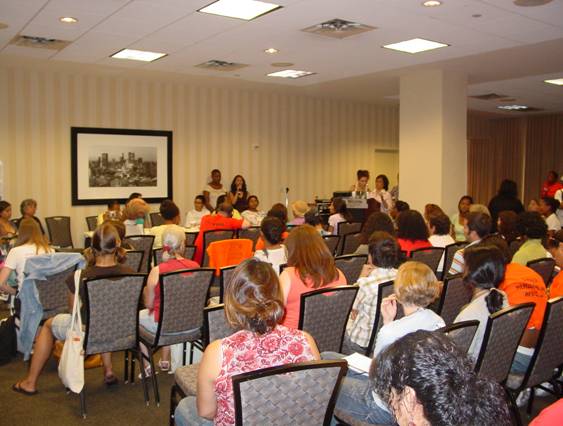
A panelist speaks to the
audience at the Domestic Workers United workshop
“Revolution for a Cooperative New World and Strategy to Achieve it”
---
Organizer: The League of Revolutionaries
for a New
Date:
Event Description: [From the USSF
website] This workshop will
discuss revolution for a cooperative new world and the path to achieving
it. This workshop has the following
goals:
- To
share our analysis of the economic and political situation – the
technological revolution and the rapidly transforming economic realities:
polarization of wealth and poverty and development of a “new” class of
workers pushed down and out of the production process transforming the
historical relationship between capital and labor within capitalism; and the
political response of the ruling class – war, fascism and intensifying
repression against every sector of society in struggle; in short social
destruction in every aspect of social life.
- To
discuss the social response happening throughout
- To
talk about political strategy for developing a cooperative society and the
relationship between the growing popular movement and the revolutionary
process; and what are the tasks of revolutionaries in this historic
moment.
The world today is in the throes of epochal economic
revolution. Transformation from industry
requiring human labor to digitally controlled production requiring little or no
human labor is the determining content of our time. Electronic production makes possible an
economic paradise of abundance for all.
Under capitalism, however, it fastens the chain of poverty ever more
tightly upon the worker. Electronic
production is creating a new class of workers everywhere, ranging from the
structurally unemployed to the destitute.
The new class cannot solve its economic problems without the public
ownership of the socially necessary means of production and the distribution of
the social product according to need.
Global unity is the condition of its emancipation. A new fascist state form, the naked rule of
corporate power, is arising to oppose the developing social motion. Revolutionaries must unite on the practical
demands of the new class and bring the people a vision of the new world. Society must take over these corporations or
these corporations will take over society.
Format will be short presentations and dialogue with League organizers
and workshop participants
Estimated # of attendees: 50-60
Composition of attendees (gender, age, ethnicity,
nationality, languages used, etc):
There were more people at this session than there were
room for; some people were crowded almost out of sight of the panelists. The majority of the attendees were
middle-aged, with about 7 younger than 30 and several appearing older than
60. Roughly two thirds of the attendees
were white; the nonwhite individuals included about 12 black, 1 Hindi, and at
least 1 Latino and 1 Asian individual. Approximately two thirds of the attendees were
men and one third were women. All of the
attendees who introduced themselves at the beginning of the session reported
that they were from the
Describe Panelists (name, organizational affiliation,
union, country, etc):
The panelists were all members of the League of
Revolutionaries for a New America.
Kimberly King is a middle-aged black woman from
Summarize speakers’ main points and any debates that
arose during the event.
The atmosphere of this workshop was markedly different
from that of the other sessions I attended.
It was more tense and conflictual, with a sense of frustrated urgency
among many of the audience members that I generally had not seen prior to this
one. I would describe this as a session
where the audience members nearly “took over.”
They seemed unsatisfied with the panelists’ statements and eager to have
their own voices heard. The audience
members who raised their hands to speak often sounded passionate, intense and
angry; some even came to the point of near shouting. All of the speakers got applause and there
was often laughter, but the sense of tension seemed to persist. I think one thing that may have contributed
to this was the format; instead of having all of the panelists make their
presentations, followed by a general discussion period, the panelists’
presentations were divided into three sections, EACH followed by questions from
the audience. This gave the audience
members more of an opportunity to speak, and may have contributed to their
frustration because they had not yet heard the rest of the panelists’
presentation. The other thing that
probably contributed to it was the nature of the workshop itself: It seemed to
draw in people from various ideological standpoints that were united only in
being “revolutionary,” while the panelists themselves adhered to a more
specific ideology. One of the panelists
whom I talked to in the beginning of the session would not give me a straight
answer about whether the organization was socialist/communist, although it
became clear during the course of the session that it was.
Kimberly King introduced the workshop and said that it
was to be divided into several sections -- the first would focus on an analysis
of the current economic and political situation in the
Following this, a young man from
The next section was to deal with the response by
popular movements to this situation.
Marian spoke about the poverty in
The third section was to be about the role of
revolutionaries and strategies to achieve political power. Beth said that society has now “caught up” to
the idea that a revolution is possible and we now can start to talk about
strategies. We need a vision of what
kind of future we want and how to achieve it.
Specifically, the working class needs to unite and obtain political
power.
By this point the audience seemed to be a little
restless, and when Kimberly asked whether they wanted to open the session up
for discussion, several of them responded yes.
Discussion:
Many hands were raised; everyone seemed eager to
speak. The speakers sounded passionate,
and the rest of the audience often interjected with encouragement or comments. The atmosphere seemed to become more intense
as the discussion went on. What struck
me was the variety of different ideologies the attendees seemed to possess.
The first to speak was a black man who said that we
need to stop giving corporations our money, and that we need to stop arguing
with one another and sit down together and get something done. He seemed to come from a religious
perspective, making reference to “our Creator.”
Another black man asked how much we need in order to
say that we have achieved our goals. Is
it okay if the rich have more than the rest of us, or do we need absolute
equality? When will it be enough? “When the working class has seized state
power,” said Marian. When everyone has
enough food, health, leisure, and education.
Speaking forcefully, she made it very clear that she was fervently
against capitalism: “To hell with giving them [the capitalists] anything. I don’t want the rich to have sh*t.” This was followed by applause from some of
the audience.
One woman asked about what specific goals
revolutionaries should have, besides simply uniting people. What is the next step? Beth said that we need to raise the
consciousness of the movement and help it get political.
One young white man declared “I’m a communist. Plain and simple.” This declaration was followed by
applause. He urged people to read Marx,
and quoted from him: “It is not the
consciousness of man that determines their being, but on the contrary, their
social being that determines their consciousness.” This means that we need to focus on educating
people, just as others before us have done, including Fred Hampton and the
Black Panthers.
Other suggestions for tactics included holding house
parties with members of the community, calling on politicians to change laws,
and creating community and worker cooperatives.
One intense young white man who seemed to be an
anarchist stood and expressed disagreement with the audience member who had
suggested using boycotts as a method of resistance to corporations. “If it’s useful property, steal it,” he said;
“if it’s not, f***ing destroy it.” (This
was followed by some applause.) We don’t
want “kinder, gentler laws,” we want to overturn capitalism. He said he was not advocating armed
revolution, but holding signs in the streets does not accomplish anything. He would prefer that people undermined
capitalism through building autonomous communities. A woman later responded to this, saying that
boycotts CAN work -- if we all withheld our money from corporations, the effect
would be huge.
The young man also accused the panel of attempting --
through worker assumption of state power -- to replace one oppressive mechanism
with another. John took exception to the
idea that the working class would become the new oppressing class. “What else has it been historically?” the
young man asked. John maintained that it
would not be like the Soviet Union -- we are seeking not a new dictatorship but
a genuinely democratic and equal society, the end of class rule altogether. Beth agreed with this, stating that economic
conditions in the world are different today from what they were at the time of
the
One of the audience members was Carl Davidson, who had
been present at the CCDS workshop yesterday. He argued that we should move AWAY from the
idea of class conflict. Not all
capitalists have to be our enemies -- there are some who can be allies, like
those he worked with on his high school project. Marian warned him that the very people he had
counted his allies would ultimately become his enemies -- it is still one class
against another. (Someone in the
audience said “Amen.”)
Perhaps the most passionate speaker was an Indian man,
who stood up near the end of the session and warned people with fervent urgency
that within the next 5 years martial law will be declared in the
The last speaker was a black woman who very
passionately stressed the need for affordable and subsidized housing.
Were plans for specific actions or future campaigns
discussed?
The audience was divided, as it was on many things, on
the kinds of specific actions that revolutionaries should take. They ranged from boycotting companies to
supporting the Farm Bill in Congress to forming worker cooperatives and
autonomous communities.
Were any cross-movement or transnational networks or
coalitions discussed?
The panelists seemed to see other movements, such as
that against racism, as subservient to or manifestations of class
conflict. Not all of the audience seemed
to agree; one young man pointed out that even if we get rid of capitalism, we
will still have an industrial society and hence will still have environmental
destruction. The panelists also saw the
Describe any evidence of networking you see among
attendees.
I saw two women exchanging business cards at the
beginning of the session. A sign-in
sheet was passed around, and Beth invited everyone interested in more
information about the League to take pamphlets and their newspaper, Rally
Comrades, and talk to the panelists after the workshop.
THEMATIC ISSUES:
The Social Forum was generally not discussed. One white man did complain that “the vast
majority of
The attendees seemed to all have radical views, but
not necessarily the same ones. The
panelists supported what was clearly a radical socialist perspective that
entailed the seizure of state power by workers.
The audience members were more divided.
The Indian man and the young reader of Marx proclaimed themselves to be
communists, while the young anarchist was very radical, but skeptical of any
use of state power. Carl seemed more
reformist, in that he did not want to talk about class conflict.
Their attitude toward current political parties was
negative. One man said that he did not
trust the Democratic Party. Marian and
Beth said that we need a new political party that represents workers.
The issue of creating a new society was framed as one
that involves the world; the participants (particularly the panelists) seemed
to identify as members of a global working class that is all exploited by
capitalism. The discussion did not focus
around the U.S. South. One woman did
bring up the issue of Katrina and asked why the government did not respond they
way it should have to that disaster.
Kimberly’s response was to tie this into capitalism in general, which at
this stage in its development does not need those people in
This was a loud, animated and altogether very
interesting workshop session. The
impression I came away with is that the radical left is still very disunited,
despite the desire by everyone to unite, but that the process of at
least beginning to talk these things out is being facilitated here at the
Social Forum.
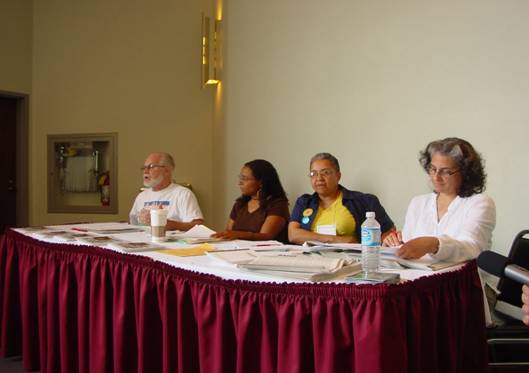
From left to right: John Slaughter, Kimberly King, Marian Kramer,
Beth Gonzales
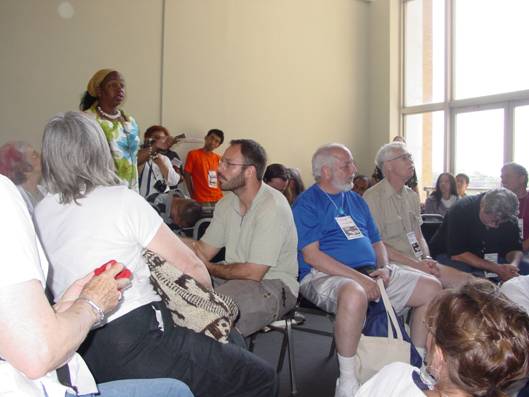
An audience member speaks at
the League of Revolutionaries workshop
“Revolutionary
Answer to Divisions Among the Oppressed”
---
Organizer: Revolutionary Communist Party
(RCP)
Date:
Event Description: [From the USSF
website] The proletariat is an
international class -- it is highly socialized and more connected than it has
ever been -- yet the ruling class works overtime to keep the masses of
proletarians from seeing their common interest and their mission as a
class. They create desperate conditions
in the communities and force the masses to compete against each other for jobs
and survival. They spew out racist ideas
that lie about people’s cultures. They
try and conceal what proletarians from different nationalities have in common
and the real strength that exists in their differences. Potentially they are the grave diggers of
capitalism -- but this potential is concealed, both from society at large and
even from the multinational proletariat itself.
Historical and continuing national oppression and sharp conditions of
inequality, along with constant ideological barrage of white supremacy have
given rise to real national divisions within the
Estimated # of attendees: 19
Composition of attendees (gender, age, ethnicity,
nationality, languages used, etc):
Attendees were 7 women and 12 men. 8 individuals were younger than 30, 1
appeared to be in his 30s, and the rest were middle-aged. There were 14 white, 3 black, and 2 Latino
individuals. One young man was from
Describe Panelists (name, organizational affiliation,
union, country, etc):
Carl Dix is a middle-aged black man and a member of
the Revolutionary Communist Party. He
was one of the “Fort Lewis Six” who spent 2 years in a penitentiary for
refusing to go to
Travis Morales is a middle-aged Latino man from
Summarize speakers’ main points and any debates that
arose during the event.
This workshop was devoted to talking about how to
bridge divisions among the working class, particularly how to unite black and
Latino immigrant workers. For the first
15 minutes, an excerpt from a DVD was shown projected on the wall. This was a talk by Bob Avakian, Chairman of
the RCP, who spoke about colonialism and imperialism. He touched on historical events like the
slave trade, Spanish conquistadors, the
Travis Morales then spoke about police brutality
during the May Day immigrant rights demonstrations; he said that it reminded
him of how black demonstrators were treated during the Civil Rights
movement. Unfortunately, a tension
exists between Latino immigrants and African Americans. Many blacks have fallen for the lie that
immigrants are stealing their jobs, while many Latinos believe that blacks are
lazy and want to rob them. He said that
he has shown the DVD of Avakian’s talk to black people, and that it has changed
their thinking about immigrants.
Similarly, part of the DVD deals with the history of black oppression in
the U.S, and showing it to Latino immigrants has enlightened their
understanding of black people. People
must be educated so that they understand that capitalism exploits both blacks
and Latinos, and that they have a shared interest in achieving a new world. Blacks, Latinos, and whites should all
struggle together for revolution, united with the international
proletariat. “Another world is possible,
and another
Carl Dix became a revolutionary in prison, after he
refused to go to
Question/Discussion Time:
One young white man asked why this discussion was
limited to only blacks and Latinos. Carl
replied that exploitation is not limited to these groups, but that they are two
very significant parts of the population and their division is a problem that
is particularly intense.
Much of the discussion focused around
immigration. One man asked for the
panelists’ opinions on legalizing illegal immigrants. Carl said that this is a just demand. People are not illegal; things like
preemptive war and torture are illegal.
Travis was a bit more cautious and said that we must be careful not to
end up with a “legalized class of slaves.”
If we legalize immigrants we must make sure that they have full rights
and access to social services. A black
woman in the audience agreed and said that the border exists only to serve
capitalism. National boundaries are
“illusory.”
A young man wondered how we can best make this
argument to skeptical people who still harbor anti-immigrant feelings. The black woman said we should make the case
that people are not illegal, the border is illegal. We should make them realize the benefits that
Travis discussed the struggle at
A young man from
A young white man commented about the strategic use of
fear by the Bush administration -- Osama bin Laden, Saddam Hussein, and now
immigrants stealing our jobs. They
benefit from this “divide and conquer” methodology. Carl agreed and said that this has a long
history.
Were plans for specific actions or future campaigns
discussed?
No really specific actions or campaigns were
discussed, other than legalizing illegal immigrants.
Were any cross-movement or transnational networks or
coalitions discussed?
The session was focused on uniting blacks and Latino
immigrants, but both Travis and Carl portrayed this union as part of a larger
struggle against capitalism that would involve people of all races and in
different countries -- a “struggle of humanity for liberation.” The struggles of black people and of
immigrants were both framed as ultimately class issues.
Describe any evidence of networking you see among
attendees.
A contact sheet was passed around. Carl invited people to get on the mailing
list if they want to know more about RCP’s program. Travis made an announcement about a
THEMATIC ISSUES:
One man noted that many workshops at the USSF have
dealt with overcoming division, and asked whether this session was saying the
same thing or something unique. Travis
replied that he supports the other sessions and that they are all united on the
theme “Another world is possible; another
The panelists were for radical change;
anti-capitalism, anti-imperialism, and the need for revolution were strong
themes. They did not discuss through
what specific means this revolution would take place. The panelists and attendees were very
critical of the Bush administration, but it was not entirely clear what role
they thought government itself should play in creating a better world. International institutions like NAFTA were
brought up only in the context of how they contribute to exploitation.
Although 6 of the 19 attendees were from
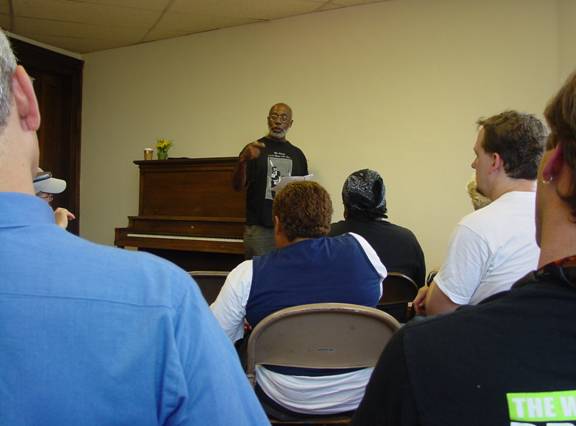
Carl Dix speaks at the RCP
workshop
“Blue-Green
Alliances: Labor Unions Do Work with Environmental Groups”
---
Organization: United Steelworkers (USW), Sierra Club
Date:
Event Description: [From the USSF
website] Historically labor unions and environmental groups have disagreed
with and distrusted each other. While
unions worried about losing jobs, environmental groups were perceived as
wanting to shutdown polluting plants above all else. But things are changing. Misunderstandings from the past are being
resolved as labor unions and environmental groups learn to work together. Labor unions are learning to see the
importance of a clean environment for the health of workers and for economic
prosperity. Environmental groups know
that workers are the first and most exposed to toxic chemicals, and are
realizing the value of collaborating with workers from polluting
facilities. Our interests can often
coincide and especially in the current political environment, we must work
together. This is why the United
Steelworkers (USW) and the Sierra Club have formed the Blue-Green Alliance
nationally and locally in certain states to create “Good Jobs, A Clean
Environment, and A Safer World.” The
Blue-Green Alliance has worked on various joint projects, including, for
example, a test case to curb the trade of certain products made from illegally
logged timber because it violates international environmental standards and
undercuts the
Our presentation will highlight an environmental and
worker-health issue we are working on locally and nationally. With other environmental, labor and community
groups, USW and Sierra Club are working to pressure the DuPont company to phase
out a toxic chemical known as the Teflon-chemical or PFOA. While pushing for the clean up of waterways
and drinking water contaminated with PFOA, our combined pressure on the company
will also protect USW workers who work with PFOA-related products. What’s even more interesting is that the
coalition understands that labor issues also exist at DuPont and the groups
have come together to draw attention to pension and retiree issues that on the
surface seem separate from environmental concerns.
Estimated # of attendees: 25
Composition of attendees (gender, age, ethnicity,
nationality, languages used, etc):
There were 12 women and 13 men at this event. Roughly half of the attendees appeared to be
under 30, with the rest middle-aged.
Four were Latino and the rest were white. Two of the participants, a man and a woman,
were French Canadian and spoke with French accents; everyone else who spoke
sounded American. Many of the attendees
were affiliated with either labor or environmental organizations. The workshop was conducted in English.
Describe Panelists (name, organizational affiliation,
union, country, etc):
The presenters were Amy Dreeke, a young white woman
affiliated with United Steelworkers, and Joshua Low, a young white man
affiliated with the Sierra Club.
Summarize speakers’ main points and any debates that
arose during the event. Include discussions of problems facing workers,
strategies for social change, etc.
Due to transportation problems I arrived at this
workshop about 30 minutes late, and missed most of the panelists’
presentation. Amy fortunately provided
me with a PowerPoint version of the presentation that she said she and Josh
followed very closely. What follows is a
summary constructed from the PowerPoint slides.
United Steelworkers (USW) and Sierra Club presidents,
Carl Pope and Leo Gerard, recently came together to sign a formal agreement
creating the Blue-Green Alliance, committed to working toward fair trade, clean
energy, reducing global warming, and reducing toxic chemicals. USW is the largest industrial union in the
Prior to this time, there was a tension between unions
and environmental groups that has prevented them from working together. Each has been focused on its particular goal
-- jobs or the environment -- without concern for the other. Environmental groups have sometimes sought to
close plants without taking into account the workers there, while workers have
stereotyped environmentalists as elitists.
Fortunately this situation has changed, as both sides have realized the
importance and benefits of working together.
It allows for both more political power and the protection of two values
-- good jobs and the environment -- that are BOTH important to American
workers. Unions can help environmental
groups by providing information about where pollution is, as well as resources
like money, networks of activists and organizational experience. Reciprocally, environmental groups can help
unions by informing workers about exposure to potentially harmful chemicals
about which the company itself might not have told them. For example, workers at several DuPont plants
did not know about their facilities’ emission of harmful dioxin until the
Sierra Club informed them.
The Teflon-chemical campaign is one example of the
work that the Blue Green Alliance has done together. Perfluorooctanoic acid, or PFOA, is one of
the chemicals used to make Teflon and other household products. It has been shown to cause birth defects, and
likely cancer, in humans. When it was
discovered that PFOA was contaminating the water around DuPont plants, the
Question/Discussion Time:
Following the panel presentation, the session was
opened up for discussion. April first
asked the audience what difficulties they foresee in getting labor and
environmental groups to cooperate, and much of the discussion focused around
this. A middle-aged Latino man stated
that he thought the issue of new plant construction could be a difficult one
for consensus formation; in
One point that came up is the need to think about
long-term strategies, like alternative energy and sustainable development,
because some production processes simply cannot be made “clean.” A middle-aged man from
Another discussion question that April asked was what
sort of language or approach is best to use to enlist workers in environmental
campaigns. How do we persuade union
members that they will not lose their jobs?
One young man suggested giving workers examples of places where
environmental protection efforts were successful, but where workers did not end
up losing their jobs, to show them that this is possible. A young woman suggested getting mothers
involved; they would be most likely to be concerned about the effects of
pollution on children in the community.
Another young woman thought the issue could be framed in terms of the
future -- pollution now is going to compromise our ability to create future
jobs. A common theme was the need to
frame environmental degradation as a community problem that affects workers
both on and off the job.
Were plans for specific actions or future campaigns
discussed?
The Teflon-chemical campaign was one specific campaign
that was discussed.
Were any cross-movement or transnational networks or
coalitions discussed?
Apart from the Blue Green Alliance itself, upon which
the session focused, there were some mentions of other movements. The theme of a clean environment as a
community issue was repeatedly mentioned, and one woman suggested making
alliances with community groups. Another
woman explicitly asked whether there were any alliances between labor and
movements like “a right to our city” that deal with community development
issues like affordable housing good transportation. One man replied that labor is often involved
through community development corporations, but a young member of USW countered
that workers rarely have much involvement in these things. Another man in the audience mentioned being a
member of a coalition involving labor and environmental as well as human rights
groups. One woman brought up the problem
of environmental racism, pointing out that black communities often suffer the
most from pollution, but no explicit links to African American or minority
advocacy groups were discussed.
Josh of the Sierra Club mentioned that he would like
to work with other unions besides the Steelworkers, such as UNITE HERE and
service worker unions.
No transnational networks were discussed. One woman did describe how she went to a
worker forum in
Describe any evidence of networking you see among
attendees.
A contact sheet was passed around near the end of the
session. The Latino man from
THEMATIC ISSUES
There was no discussion of the USSF/WSF process.
The attendees seemed to want reformist change and none
of them seemed explicitly anti-capitalist.
The most radical may have been the woman who visited
The roles of government and international institutions
were not discussed. The International of
the AFL-CIO was brought up several times; the point was made that it lacks the
power to force local unions to do anything, so that even if the International
were to take a progressive environmental stance, it would not mean that local
unions would be as willing to cooperate with environmental groups.
Both the local and the national seemed present in the
discussion. Attendees often talked about
the particular geographical areas they were from, and seemed to agree that
environmental protection and ensuring good jobs were issues in which local
communities needed to be involved. Much
of the discussion centered around coal and the Appalachia region, but it was
not limited to the US South and no one who spoke indicated being from
I heard no evidence that participants identified with
the WSF itself or with a global process or movement. They seemed to identify with the labor and/or
environmental movements, and perhaps with movements around human rights and
community development, but nothing necessarily on a larger scale than that.
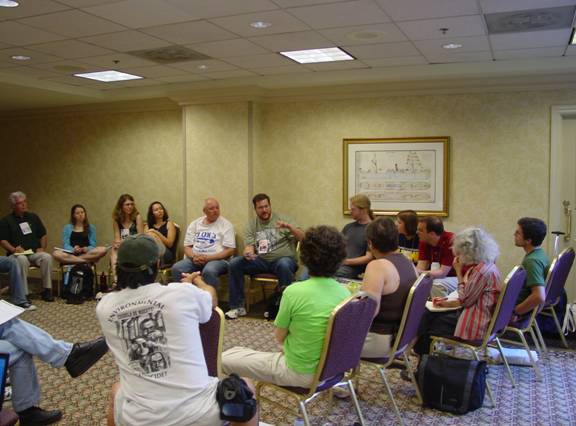
Joshua Low (red shirt, under
the painting), Amy Dreeke (to his right), and others listen as a participant
speaks during the workshop discussion period.