Comrades-in-Arms?:
Socialists and Communists at the World Social
Forum
Bridgette Portman
Sociology 240A
v. 8/3/08, 7440 words
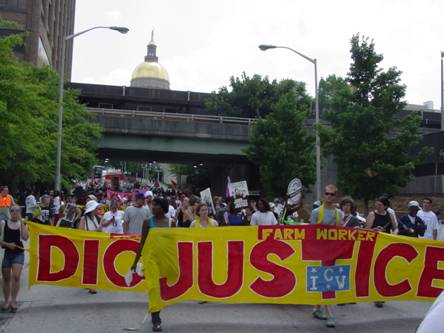
Activists march in a parade during the US Social Forum
in

UCR
Institute for Research on World-Systems
University of California-Riverside
Paper presented at the Critical Sociology
conference on “Power and Resistance: Critical Reflections, Possible Futures,”
This is IROWS Working Paper #38 available at https://irows.ucr.edu/papers/irows38/irows38.htm
The
World Social Forum and the related “global justice movement” are generally
considered to be novel phenomena, creative forms of opposition to the relatively
novel process of neoliberal capitalist globalization. This paper asks to what extent older social
movements – specifically, socialist and communist movements – are involved in
the World Social Forum and the global justice movement. How have these older, and some would say
Western-centric, movements responded to the “new” Social Forum process centered
in the global South, and to the “family of movements” involved in it
(Wallerstein 2004a, 634)? Are there
significant cleavages between socialists and communists and other global
justice activists in terms of demographics, group affiliations, or issue
opinions? If so, what implications might
such cleaveages suggest for the future of the global justice movement?
This paper is divided into several sections. First, the World Social Forum and its
connection to the global justice movement will be discussed. Evidence will be presented that indicates that
socialists and communists may be a peripheral rather than a central part of this
movement. Then results will be presented
from an analysis of survey data collected at the 2005 World Social Forum held
in
The World Social Forum and the Global Justice Movement
The World Social Forum (WSF) is an annual congregation
and meeting space for a wide variety of social movements, including
environmentalists, workers, feminists, gay rights activists, indigenous groups,
and human rights activists, united in – if nothing else – their opposition to
neoliberal capitalist globalization. The
WSF was first held in
I said, “We need a symbolic rupture with
everything Davos stands for. That has to
come from the South.
Since 2001 the WSF has become
an annual event and has been held in
The
WSF prides itself on the fact that it is organized differently from many other
entities: it is an “open space” in which social movements and activists can
exchange knowledge and ideas in a decentralized, non-hierarchical fashion. According to the Charter of Principles
developed by the WSF International Council (2001, #8), “The World Social Forum
is a plural, diversified, non-confessional, non-governmental and non-party context
that, in a decentralized fashion, interrelates organizations and movements
engaged in concrete action at levels from the local to the international to
build another world.” Indeed, plurality
and diversity are the WSF’s organizing logic.
At each Forum numerous organizations hold workshops focused around
specific themes or topics. There are
also events, such as parades and the “Assembly of Social Movements,” that
involve large numbers of Forum members collectively, but for the most part the
WSF remains quite decentralized.
Although criticisms of this structure will be discussed later, many
activists see these organizational principles as beneficial.
The
WSF has been described as an outgrowth or manifestation of a wider movement
opposed to the consequences of neoliberal capitalist globalization. This movement has many
names: the “global justice
movement,” the “anti-globalization movement,” the “alter-globalization
movement,” the “anti-capitalist movement,” the “family of anti-systemic movements.” In the words of the WSF itself, it is the “global movement for social justice and solidarity” (Call of
Social Movements 2002, #11). In
reality, it is not a single movement, but
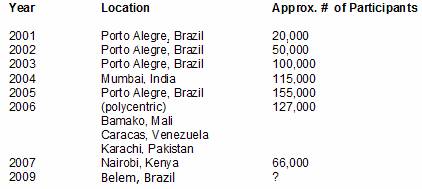
Table 1:
World Social Forums[1]
encompasses a wide variety of
different social movements, including “women, people
of color, indigenous people, homosexuals, oppressed nationalities, immigrants,
students, youth, the elderly, ecological groups, cultural movements, [and] landless and homeless
populations” (Leite 2005, 39). The WSF describes
this amalgamation in the following way:
We are diverse -- women and men, adults and youth, indigenous peoples,
rural and urban, workers and unemployed, homeless, the elderly, students,
migrants, professionals, peoples of every creed, colour and sexual
orientation. The expression of this
diversity is our strength and the basis of our unity. We are a global solidarity movement, united
in our determination to fight against the concentration of wealth, the
proliferation of poverty and inequalities, and the destruction of our earth.
(Call of Social Movements 2002, #2)
The global
justice movement – as this paper will refer to it – is generally thought of as
a new phenomenon, having arisen to counter the relatively new phenomenon of
neo-liberal globalization.[2] Its somewhat shallow roots extend back to the
1999 anti-WTO protests in
Socialists and Communists within the WSF and Global Justice Movement
Given the purported
“newness” of the WSF and global justice movement, what is its relationship to “old”
leftist movements, such as socialists and communists, who have a much longer
history of resisting global capitalism?
On the one hand, “old” social movements – including socialists,
communists, anarchists, and labor advocates – have played an undeniable part in
the WSF process. According to Walden
Bello, it is useful to think of the WSF and the global justice movement as “a
mix of the old and the new”:
You have the coming together of different
streams: the Marxists influence the stream, there is an ecological
environmental stream, the feminist stream, the radical developmentalist stream
and what is interesting is the interaction of all these streams both
theoretically and politically. There has
been a creative cross-fertilisation of the different traditions. (ctd in Ashman
2004, 148)
Socialist and communist
groups have organized panels and workshops at the WSFs. At the United States Social Forum (USSF) in
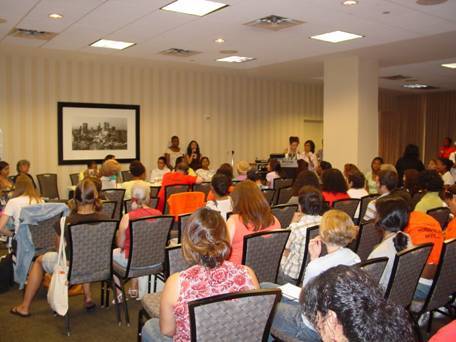
A Workshop at
However, relative to the WSF and the global justice movement
overall, socialist and communist views are not necessarily central.
For
some, socialism is still an adequate designation, however abundant and
disparate the conceptions of socialism may be.
For the majority, however, socialism carries in itself the idea of a
closed model of a future society, and must, therefore, be rejected. They prefer other, less politically charged
designations, suggesting openness and a constant search for alternatives…according
to some, the idea of socialism is West-centric and North-centric… (113-14).
It could be that
some Forum participants avoid identifying themselves with “socialism” or
“communism” for strategic reasons, while still accepting the ideas associated
with those ideologies. They might
instead frame their arguments around the idea of workers’ rights or social
justice. This seems plausible given a
conversation between two activists that took place at a workshop organized by
Solidarity at the USSF:[3]
Older Woman: Anytime you
say you’re a socialist, people say – you know, they come up with what sound
like clichés, but they’re serious – they say, “that’s never worked, how could
that work?”
Younger Woman: Don’t say
it.
Older Woman: Well, but if
you’re a member of the organization…
Younger Woman: I think that the working class in the United States
is just not radical enough to quite relate, and so I’m just saying to get to
their issues, talk about their issues, and we can save the other things
[socialism] for another day…don’t get hung up on it.
There is no evidence,
however, that the majority of Forum-goers do indeed accept the fundamental
elements of socialist and communist ideology, at least in its classical Marxist
incarnation. On the contrary, Waterman
(2005) notes that “the WSF opposes itself or distances itself (or is autonomous from) the
state-national, the inter-state institution, political parties, militarism and
insurrection, institutionalized unionism, from Marxism, socialism and
class-struggle (at least as the primary motive force of history)” (45). This rejection of economics as the primary
determinant of social life is evident in the WSF Charter of Principles, which
states that “the World Social Forum is
opposed to all totalitarian and reductionist views of economy, development and
history” (#10). Leite argues that “While a large number of forum participants identified with
some form of socialism, the majority was very distant from any type of
tradition linked to the international socialists of the twentieth century”
(96). And Waterman (2005) argues that
even labor issues in general have taken a somewhat peripheral role at the
Forum:
Within the context of the WSF, if not possibly also of the GJ&SM
[global justice and solidarity movement] more generally, labour and labour
struggles have never been a major theme, nor a cross-thematic issue. Labour questions have been typically presented
either in the largely ossified form of the traditional unions…or as separate
issues concerning worker rights, women workers, migrants, rural labour, land
reform, the social economy, etc. (46)
Some well-known leftist scholars have
chimed in on this issue. World-systems
scholar Immanuel Wallerstein (2004a) argues that the WSF is an embodiment of a
new “family” of anti-systemic movements that is opposed in fundamental ways to
the “old left” – specifically, communist, social democratic, and national
liberation movements. In particular, he
argues that the “new left” eschews the old left’s strategy of utilizing state
power to achieve reforms, is skeptical of political parties, and rejects the
idea that the conflict between capital and labor is the most important source
of exploitation in society. Given that
these are concepts associated with classical Marxism and communism, one would
expect that many members of the “new left” would not associate themselves with
those older movements. Additionally,
Marxist author Alex Callinicos (2003) is careful to distinguish socialism from
the rest of the anti-capitalist movement (his term for the anti-globalization or
global justice movement). According to
Callinicos, “The distinctive character
of the contemporary anti-capitalist movement reflects its emergence in an
ideological climate defined by the apparent triumph of liberal capitalism and
the eclipse of Marxism” (84). He goes on
to note that “supporters of the FI [the Trotskyist Fourth International] from
both Latin America and Europe have been heavily involved in the World Social
Forms at Porto Alegre,” but that “they remain very much a minority force,” and
that “the idea that socialism is the alternative to capitalism has as yet
little currency in the movement, in the North at least” (85).
Some
socialist and communist groups have expressed criticism of the WSF specifically
because it is not socialist enough.
At the 2004 WSF in India, this took the form of the “Mumbai Resistance”
(MR), a gathering of radical Maoist groups that was intended as an alternative
and challenge to the WSF – although it garnered only
about two percent of the turnout witnessed at the WSF (Wallerstein 2004b). According
to Ching (2004), an attendant at the MR,
MR 2004 has criticized the WSF for
promoting the idea of “another world is possible” without actually explaining
the content of that world. MR 2004 has pointed out that the WSF has pinned
peoples’ hope on a vague and abstract world that does not have any concrete meaning.
MR also believes that another world is
possible and the future world MR 2004 pursues has very precise content: a world
advancing toward socialism. (335)
MR also criticized the WSF for its
exclusion of political parties and groups that use violence. Another criticism comes from communist P. J.
James (2004):
The so-called ‘pluralism’ advocated by
the WSF, its close affinity to ‘new social
movements’ (NSMs), and its hatred
towards class movements, all have wider ideological ramifications. Their roots
lie deep in the post-Marxist prognosis on the decline or disappearance of the
working class as a revolutionary force and the ascendancy of NSMs and NGOs as
the “new revolutionary subject of history.” (248)
In addition, a common critique offered
by socialists and communists is that the WSF’s decentralized, non-political structure and failure to plan or advocate
specific actions has rendered the Forum nothing more than “talking shop.” Rather than an “open space,” these groups
would like to see the WSF become something more organized and agentive. “Our overall aim must to be create a new world
political organisation,” writes the League for the Fifth International (2006),
“whose declared objective is to bury capitalism and imperialism once and for
all, and build another world - a socialist one.”
It
is probably partly the perceived failure of “socialism” in
The
Social Forum that we’re at is overwhelmingly people of color and young
people. We don’t reflect that and it’s a
problem for us. And I think it’s a
problem in terms of the conversation that we’re having because most people at
the Social Forum, if they ask, ‘how are we going to rebuild a movement in the
Given
these issues, this paper asks the following question: To what extent have socialist and
communist activists become part of this “new” global justice movement, and
particularly the WSF process? Are there
significant cleavages between them and other Forum participants in terms of
demographics, issue opinions, and group affiliations?
Methods
This paper
draws upon survey data collected from participants at three different Social Forums:
the Fifth WSF, held from January 26-31,
2005, in
The
Check
all of the following movements with which you:
(a)
strongly identify: (b)
are actively involved in:
oAlternative media/culture oAlternative media/culture
oAnarchist oAnarchist
oAnti-corporate oAnti-corporate
oAnti-globalization oAnti-globalization
oAlternative
Globalization/Global Justice oAlternative
Globalization/Global Justice
oHuman
Rights/Antiracism oHuman Rights/Antiracism
oCommunist oCommunist
oEnvironmental oEnvironmental
oFair
Trade/Trade Justice oFair Trade/Trade Justice
oGay/Lesbian/Bisexual/Transgender/
Queer Rights oGay/Lesbian/Bisexual/Transgender/Queer
Rights
oHealth/HIV oHealth/HIV
oIndigenous oIndigenous
oLabor oLabor
oNational
Sovereignty/National Liberation oNational Sovereignty/National
Liberation
oPeace/Anti-war oPeace/Anti-war
oFood
Rights/Slow Food oFood Rights/Slow Food
oSocialist oSocialist
oWomen's/Feminist oWomen's/Feminist
oOther(s),
Please list ________________ oOther(s), Please list _______________
Figure 1: List of social movements on the 2005 survey
at
identifying with or being actively involved in any
movement. Since I was interested in how
socialists and communists differ from other activists, I felt it would
be inappropriate to include those individuals – such as researchers,
journalists, and curious bystanders – who were attending the forums for reasons
other than movement affiliation. This
left 562 respondents in the
Hypotheses
I have divided my analysis into three
sections: demographic factors, opinions, and affiliations with groups and
movements. In terms of demographics, I
expect that H1: socialists and communists will be older, on average, than
other Forum attendants. This makes
sense given that the movements themselves are older; older individuals would
likely have joined the movements prior to the collapse of the
In terms of issue opinions, I predict that H6: socialists
and communists will be more radically anti-capitalist than the other Forum
attendants: they will be more likely to want to abolish capitalism rather
than reform it, and also more likely to want to abolish the economic
institutions of global capitalism – the IMF, the WTO, and the World Bank. I also expect that H7: they will be more
supportive of the idea of world government.
This follows from socialism’s universalist aspirations; to quote the Communist
Manifesto, “the working-man has no country.” Also, congruent with the criticism posed by
some socialist and communist groups that the WSF is not “political” enough, I
expect that H8: socialists and communists will be less supportive than other
Forum-goers of the organization of the WSF as a nonpolitical, decentralized
“open space.”
Regarding group
affiliations, I expect that H9: socialists and communists will be more
likely than other Forum attendants to be affiliated with labor unions,
given socialism’s focus on labor as the agent of progressive change. I also predict that H10: they will be more
likely to be affiliated with political parties, given the nature of
socialism as a very political ideology centered around the use of state power
to achieve societal change, and the fact that there are a great many socialist
and communist parties in existence (as opposed to, say, feminist parties, or
parties centered around other movements).
Findings
Altogether there were 403
socialists and 183 communists in the sample (Figure 2). The striped area in Figure 2 represents the
overlap – 112 people identified with both communism and socialism. Due to the relatively small overlap, I
thought it would be appropriate to separate my analysis of socialists from my
analysis of communists. Hence, the two
groups are treated individually. Figure
3 breaks down the percentage of socialists and communists by meeting site.
Two things are immediately noticeable. First, as expected, socialism and communism
are not

Figure
2: Socialists and communists as a
percentage of total sample
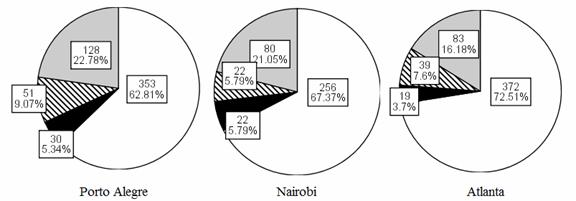
Figure 3: Percentage of socialists and communists by
meeting
dominant affiliations among participants at the Forum;
two-thirds of the sample identify with neither socialism nor communism. Second, in accordance with H5, socialists and
communists comprise a smaller percentage of the sample in
Demographics
A logistic regression
was run to determine the probability that a respondent would indicate being a
socialist, using meeting site, gender, race, age, and years of education as
predictive factors. Table 2 presents the
results. As
hypothesized, there was a statistically significant partial effect of meeting
location: The odds of being a socialist at the WSF in
When
the same regression was run for communists (Table 3), only gender had a
statistically significant partial effect.
Men were 1.55 times as likely to be communists than were women.
|
Predictor |
B |
Wald c2 |
P |
Odds Ratio |
|
Meeting |
|
|
|
|
|
|
.345 |
4.469 |
.035 |
1.412 |
|
|
.329 |
3.108 |
.078 |
1.390 |
|
Gender |
.389 |
8.305 |
.004 |
1.476 |
|
Education |
-.182 |
1.626 |
.202 |
.833 |
|
Age |
|
|
|
|
|
25
and under |
.154 |
.879 |
.348 |
1.167 |
|
26
to 35 |
-.044 |
.069 |
.793 |
.957 |
|
Race/Ethnicity |
|
|
|
|
|
Black/African |
-.399 |
4.147 |
.042 |
.671 |
|
Latino/Hispanic |
-.050 |
.043 |
.836 |
.951 |
|
Mixed or other |
-.185 |
1.260 |
.262 |
.831 |
Table 2:
Results of logistic regression predicting socialism from meeting
location, gender, education, age, and race/ethnicity
|
Predictor |
B |
Wald c2 |
P |
Odds Ratio |
|
Meeting |
|
|
|
|
|
|
.065 |
.090 |
.765 |
1.068 |
|
|
-.014 |
.003 |
.957 |
.986 |
|
Gender |
.440 |
5.781 |
.016 |
1.552 |
|
Education |
-.329 |
2.994 |
.084 |
.719 |
|
Age |
|
|
|
|
|
25
and under |
.355 |
2.493 |
.114 |
1.427 |
|
26
to 35 |
.284 |
1.545 |
.214 |
1.329 |
|
Race/Ethnicity |
|
|
|
|
|
Black/African |
.009 |
.001 |
.970 |
1.009 |
|
Latino/Hispanic |
.195 |
.598 |
.439 |
1.216 |
|
Mixed or other |
.213 |
.452 |
.502 |
1.237 |
Table 3:
Results of logistic regression predicting communism from meeting
location, gender, education, age, and race/ethnicity
Issue Opinions
A number of
crosstabulations were performed to determine whether socialists and communists
differed from other Social Forum participants in their opinions on issues
related to globalization and capitalism.
The prediction that socialists and communists would be more radically
anti-capitalist than other activists was largely supported. Both socialists and communists were more likely
to prefer abolishing capitalism over reforming it (Table 4). Given that the abolishment of capitalism and
its replacement by some form of collective ownership of the means of production
is the quintessential socialist goal, this is not surprising. What
may be more interesting is that a sizeable minority of both socialists and
communists advocated reforming capitalism rather than replacing it. Because socialism and communism by definition
seek the replacement of capitalism, it would seem that these inconsistent
attitudes need to be explained. This
matter will be re-examined in the Discussion. In addition, both socialists and
|
Reform or Abolish
Capitalism? |
Socialist |
Non-Socialist |
Communist |
Non-Communist |
|
Reform it |
32.4% |
48.0% |
22.1% |
46.7% |
|
Abolish it |
67.6% |
52.0% |
77.9% |
53.3% |
|
|
Χ2 = 26.58
p < .001 |
Χ2 =
36.85 p < .001 |
||
Table 4
|
World Bank |
Socialist |
Non-Socialist |
Communist |
Non-Communist |
|
Reform it |
28.6% |
39.9% |
21.7% |
39.0% |
|
Abolish it or Replace it |
71.4% |
60.1% |
78.3% |
61.0% |
|
|
Χ2 = 8.26
p = .004 |
Χ2 =
10.33 p = .001 |
||
Table 5
communists were more likely to want to abolish or
replace, as opposed to reform, the World Bank (Table 5).[7] They were also more likely to want to abolish
or replace the IMF, but this reached significance only for socialists (χ2 = 5.00, p =.025). On the other hand, communists, but not
socialists, were significantly more likely to want to abolish or replace the
WTO (χ2 = 3.91,
p =.048). Also
as expected, both socialists and communists were more likely to disagree with
the idea that the Social Forum should remain a nonpolitical “open space” and
not take positions on issues. However,
this was just shy of significance for communists (see Table 6).[8] Finally, contrary to my prediction,
neither socialists nor communists were more likely than other Forum attendees
to support the idea of world government.
Roughly 40% of both socialists and communists felt that a democratic
world government was a good idea and possible to achieve, a slightly but not
significantly larger proportion than the rest of the sample.
|
WSF should remain open
space |
Socialist |
Non-Socialist |
Communist |
Non-Communist |
|
Agree |
50.0% |
58.1% |
47.5% |
56.9% |
|
Disagree |
50.0% |
41.9% |
52.5% |
43.1% |
|
|
Χ2 = 4.95 p = .026 |
Χ2 =
3.70 p = .054 |
||
Table 6
Group and Movement Affiliations
H10
predicted that socialists and communists would be more likely to be affiliated
with a political party. This was confirmed
(Table 7), although roughly three-fourths of both socialists and communists did
not indicate having a party affiliation. Socialists and communists were also more
likely to be union affiliates (Table 8), although this was just shy of
significance for communists.
|
Political party
affiliation |
Socialist |
Non-Socialist |
Communist |
Non-Communist |
|
Yes |
23.2% |
8.6% |
25.2% |
10.9% |
|
No |
76.8% |
91.4% |
74.8% |
89.1% |
|
|
Χ2 = 49.72 p < .001 |
Χ2 =
25.67 p < .001 |
||
Table 7
|
Union affiliation |
Socialist |
Non-Socialist |
Communist |
Non-Communist |
|
Yes |
26.0% |
15.8% |
24.1% |
17.8% |
|
No |
74.0% |
84.2% |
75.9% |
82.2% |
|
|
Χ2 = 17.75 p < .001 |
Χ2 =
3.53 p = .060 |
||
Table 8
The final
factor at which I looked was whether socialists and communists were affiliated
with other social movements at the WSF and USSF. I coded a participant as an affiliate of a
given social movement if he or she checked “strongly identify” and/or “actively
involved” next to that movement on the survey.
Because there was no limit on the number of movements a subject could
check, many people were “synergists,” or affiliates of more than one
movement. I wondered whether socialists
and communists would be affiliated with fewer movements than others, which
would indicate that they formed a relatively insular group at the Forum. In fact, nearly all socialists and communists
in the sample were synergists – only four socialists were affiliated with
socialism alone, and only three communists were affiliated with communism
alone. The median number of movements with
which socialists and communists were affiliated was 10. Since the surveys at each meeting contained a
different number of total movements from which respondents could choose, it may
be more meaningful to break down the results by meeting (Table 9).
It appears that both socialists and communists are well connected with
other movements at the Forum.
|
|
Socialista |
Communistb |
Total # of movements on
survey |
|
|
8 |
9 |
18 |
|
|
10.5 |
9.5 |
27 |
|
|
14 |
13 |
27 |
a Including “socialist” and excluding “other”
b Including “communist” and excluding “other”
Table 9: Median number of social movement affiliations
for socialists and communists
Table 10 displays the percentage of individuals in
each movement at
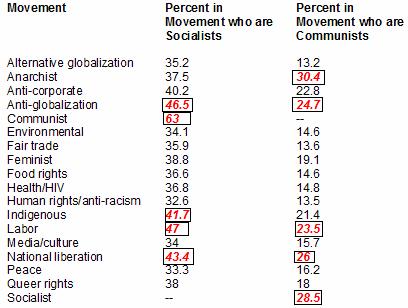
Table 10 (
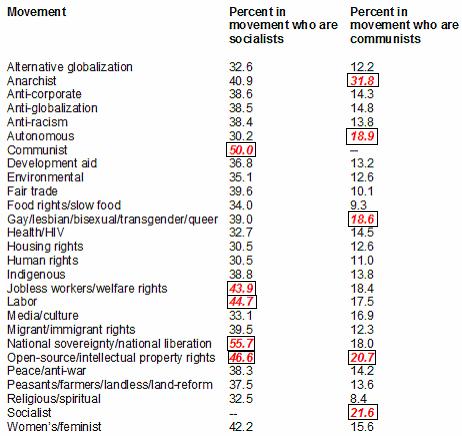
Table 11 (
socialists and communists was anti-globalization,
understandable if globalization is identified with the rule of global
capital. On the other hand, socialists
and communists were not as centrally involved in “newer” social movements like
health/HIV, queer rights, media/culture, environmentalism, and feminism. One unexpected finding was the connection
between communism and anarchism; given the history of sometimes very bitter
ideological conflict between communists and anarchists, it seems strange that
nearly one third of the individuals identifying with anarchism in the
Table 11
displays the results for the
Finally,
the results for the USSF in
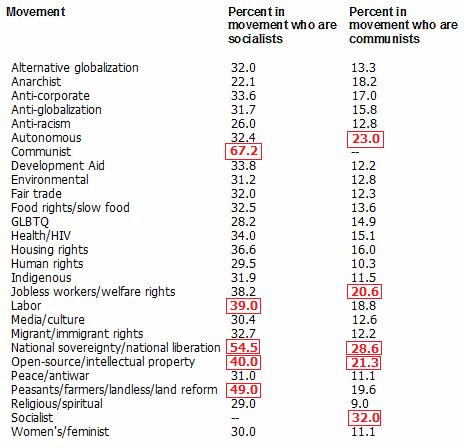
Table 12 (
To
summarize, socialism and communism do not seem to be isolated movements at the
WSF. Rather, the vast majority of these
individuals were also members of other movements. Chief among these are the labor and national
liberation movements, which are generally considered “old” movements and which
have historical ties to socialism. Socialists
and communists may find it easier to relate to these movements than to the
“new” social movements – like environmental, feminist, or gay and lesbian
rights – which do not generally focus on economic issues as a primary source of
exploitation.
Discussion
Table 13
presents a summary of this paper’s findings.
Overall, I found partial support for my hypotheses. In terms of demographics, socialists and
communists were significantly more likely to be male than female. Whether this reflects the historical concern
of socialism with the predominately male working class, and whether women tend
to be drawn instead to other movements, such as feminism, that they percieve as
more conducive to their interests, is a question for further study. On the other hand, in terms of age,
educational attainment, and race/ethnicity, socialists and communists generally
mirrored the rest of the sample – with the exception that socialists (but not
communists) were more likely to be white rather than black.
Finally, as expected, there were fewer socialists and
communists at the USSF in
Turning to issue opinions, results were
also mixed. On the one hand, socialists
and communists were more radically anti-capitalist than were other activists at
the Forum, as evidenced by their preference to abolish rather than reform
capitalism and capitalist institutions.
|
Supported |
H2: Socialists and
communists will be more likely to be male H6: Socialists and
communists will be more radically anti-capitalist than the other Forum
attendants H10: Socialists and
communists will be more likely to be affiliated with political parties |
|
Partially Supported |
H3: Socialists and
communists will be more likely to be white [black individuals were less
likely to be socialists, but not less likely to be communists] H8: Socialists and
communists will be less supportive of the WSF as an “open space” [This was
significant for socialists only] H9: Socialists and
communists will be more likely to be affiliated with labor unions [This
was significant for socialists only] H5: Socialists and communists will constitute a
smaller percentage of total Forum attendees at the USSF than they will in |
|
Not Supported |
H1: Socialists and
communists will be older, on average, than other Forum attendants H4: The average level of
educational attainment for socialists and communists will be lower than that
of other Forum attendants H7: Socialists and
communists will be more supportive of the idea of world government |
Table 13: Summary of findings
On the other hand, they were not more likely than other
activists to support the idea of world government. In fact, a majority of them felt that a
democratic world government was either a bad idea or a good but implausible
idea. Socialists, but not communists,
were less supportive of maintaining the Social Forum as a nonpolitical “open
space.” While a majority of other Forum
attendants supported the idea of open space, socialists were evenly split on
the issue.
Finally,
regarding group affiliations, both socialists and communists were more likely
than other activists to be members of political parties, and socialists were
more likely to be union members. They
were connected to other movements at the Forum and did not form an isolated
group, although they tended to have more ties to the classical allies of
socialism – labor and national liberation movements – than to newer movements
like feminism or environmentalism.
The overall results of this analysis
suggest that while socialists and communists are not a dominant part of the WSF
process, and while they have some differences with other Forum participants
regarding issue opinions and group affilations, these differences do not seem
to be overwhelming. This could be
considered good news for the global justice movement. Of course, caveats are in order. First, the fact that socialists and
communists do not seem to be significantly different from other WSF
participants cannot be taken to mean that this is true for socialists and
communists in general. This
analysis looked at a self-selected sample of socialists and communists – those
who decided to participate in the Forum.
It could be that socialists and communists who did not go to the
Forum, such as those who attended the Mumbai Resistance instead, differ in
significant ways from those who were surveyed here. Recall the finding that a considerable
minority of socialists and communists surveyed indicated that they believed
capitalism should be reformed rather than abolished. Perhaps this is evidence that these
individuals were not strongly attached to socialism and communism or did not
have a sophisticated understanding of the ideologies. This might also explain why a considerable
number of communists were affiliated with anarchism; perhaps they did not
understand either ideology well enough to recognize the contradictions between
the two.
It is also
likely that “socialism” and “communism” have different meanings for different
people. For instance, one person might
associate socialism with a classless society and abolition of the market, while
another might have a more moderate definition focused around stronger rights
for workers or reducing economic inequality – more of a social democratic than
a truly socialist outlook. The latter
definition is probably more likely among people from countries that have large
established socialist parties. For
example, some individuals in
That said, these findings
may still be considered “good news” for those supporters of the WSF and the
global justice movement, such as Wallerstein, who hope that this new “family of
social movements” can muster enough internal solidarity – despite all its
pluralism – to be a force for change. Perhaps
it is true that, in the words of Cassen (2003) “A global constellation is
coming into being that is beginning to think along the same lines, to share its
strategic concepts, to link common problems together, to forge the chains of a
new solidarity” (59).
References
Ashman, S. (2004). Resistance to neoliberal
globalization: a case of “militant particularism”?
Politics, 24(4), 143-153.
“Call of social movements.”
(2002). In J. C. Leite (2005), The World Social Forum: strategies of
resistance (pp. 187-195).
Callinicos, A. (2003). An anti-capitalist manifesto.
Cassen, B. (2003). On the attack. New Left Review, 19,
41-60.
Chase-Dunn, C. (1998). Global formation: structures
of the world economy. Rowman &
Littlefield.
Ching, P. (2004). Critical views of the World Social
Forum – from Mumbai Resistance.
Inter-Asia Cultural
Studies, 5(2), 331-335.
Giugni, M.,
Bandler, M., and Eggert, N. (2006). The global justice movement: how far does
the classic social movement agenda go in explaining transnational contention? United
Nations Research Instititute for Social Development, Civil Society and
Social Movements Programme Paper Number 24.
IBASE. (2007). World
Social Forum: An x-ray of participation in the policentric forum 2006,
James, P. J. (2004). The World Social Forum’s “many
alternatives” to globalisation. In Jai Sen, Anita
Anand, Arturo Escobar, & Peter Waterman (eds.) (2004), World Social Forum:
challenging empires (pp. 246-250).
Kitschelt, H. (1986). Political opportunity structures
and political protest: Anti-nuclear
movements in four
democracies. British Journal of Political Science, 16, 57-85.
League for the Fifth International. (2006). 2006 World
Social Forum meets in three
centres. Online at
<http://www.fifthinternational.org/index.php?id=14,366,0,0,1,0>
Leite, J. C. (2005). The
World Social Forum: strategies of resistance.
Books.
March, L., & Mudde, C. (2005). What’s left of the
radical left? The European radical left
after 1989: decline and
mutation. Comparative European Politics, 3, 23-49.
Reese, E., Herkenrath,
M., Chase-Dunn, C., Giem, R., Guttierrez, E., Kim, L., & Petit, C.
North-South contradictions and bridges at the World Social Forum. Forthcoming
in Rafael Reuveny and William R. Thompson (eds.) North and South in the
world political economy. Available online at
<http://www.irows.ucr.edu/papers/irows31/irows31.htm>
globalization (part 1).
Paper presented at the XXIV International Congress of the Latin American
Studies Association. Online at <http://www.choike.org/documentos/wsf_s318_sousa.pdf>
--------. (2006). The rise of the global left: the
World Social Forum and beyond.
Zed Books.
Tarrow, S. (1994). Power in movement: Social
movements, collective action and politics.
Wallerstein,
---------. (2004a). The dilemmas
of open space: the future of the WSF. International Social
Science Journal, 56.182,
629–637.
--------- . (2004b).
The rising strength of the World Social Forum. Commentary No. 130,
Waterman, P. (2002). Reflections on the 2nd World
Social Forum in
left internationally?
Working Paper Series No. 362, Institute of Social Studies,
----------. (2003). The global justice and solidarity
movement and the World Social Forum: a
backgrounder. In Jai Sen,
Anita Anand, Arturo Escobar, & Peter Waterman (eds.) (2004), World
Social Forum: challenging empires (pp. 55-66).
----------. (2005). The
old and the new: dialectics around the Social Forum process. Development,
48(2), 42-47.
World Social Forum International Council. (2001). WSF
charter of principles. Online at
<http://www.forumsocialmundial.org.br/main.php?id_menu=4&cd_language=2>