Global
state formation: modeling the rise, fall and upward sweeps of large polities in
world history and the global future
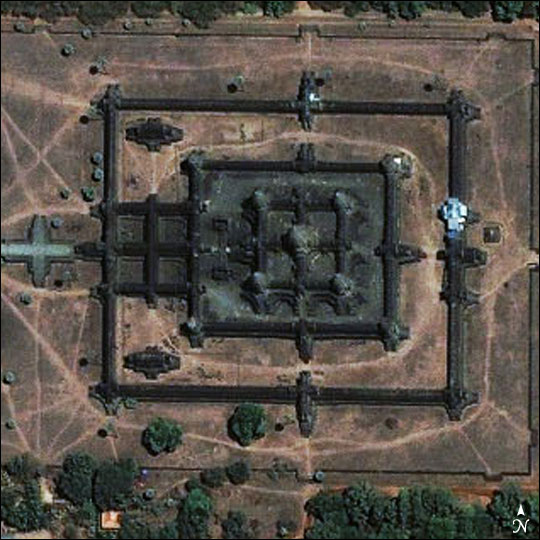
angkhor wat
Christopher
Chase-Dunn
Sociology, University of California-Riverside
Eugene N. Anderson
Anthropology, University of
California-Riverside
Peter Turchin
Ecology and Evolutionary Biology, University of
Connecticut
v. 8/23/05
An
earlier version was submitted to the National Science Foundation’s Human and
Social Dynamics (research-focused project initiative,
subcontract to UCONN, collaborate with ESRI (Redlands).
NSF 05-520 Human and Social Dynamics http://www.nsf.gov/pubs/2005/nsf05520/nsf05520.htm
Topical area: "agents of change" AOC
Designated as Full Research Proposal
Due to NSF February 23, 2005.
Start date: October 1, 2005.
36 months
Project Summary
Patterns of
expanding state formation constitute a long-term evolutionary trend that will
probably eventually result in the emergence of a single world state. The very
nature of the expansion of political integration has itself evolved because new
institutions that facilitate regional integration, cooperation and conflict
have emerged. Military conquest and the
long-term interaction between sedentary agrarian empires and confederations of
pastoral nomads came eventually to be replaced by a process of geopolitical and
economic competition among states in a world that has increasingly been
integrated by market exchange. In the last 200 years international governmental
and transnational non-governmental organizations have emerged that constitute
the first beginnings of world state formation, and the national states have
been partially reconfigured as instruments of an increasingly integrated global
elite. World state formation may be desirable because the problems created by
human technological and social change are increasingly global in scope. But a
world state will need to be legitimated in the eyes of a majority of the human
population of the Earth and this means that democracy must be constructed on a
global scale. This proposed project
will allow us to examine several probable future trajectories of global
political integration based on models of growth, decline and systemic
transformation that are developed by studying patterns of political integration
in several regions over the past 3000 years.
The main purpose of the
proposed project is to study and model the growth of states in selected regions
of the world over the past 3000 years. In the nineteenth and twentieth
centuries expansion and intensification of intercontinental interactions has
been called globalization. But earlier regional systems also exhibited similar
waves of “globalization,” albeit on a smaller spatial scale, and these waves of
network expansion and contraction, punctuated by occasional huge jumps in the
scale of networks, eventually led to the formation of the modern global social
system. This project will study the spatial nature of interaction networks over
time and the relationship between these networks and the growth decline/phases
of cities and states. The three-year project will develop, parameterize and
test models of social change using newly upgraded estimates of the sizes of
cities and states, climate change, trade routes, and warfare.
Intellectual Merit
The project will develop a new theoretical
synthesis based on Peter Turchin's (2003) model of the dynamics of agrarian
state growth and decline, network theory, a population pressure and ecological
model, and explanations of the rise and fall of modern hegemons. The
"agents of change" focus will test the hypothesis of “semiperipheral
development” – the idea that that it has mainly been semiperipheral societies
that have expanded networks, made larger states, and innovated and implemented
new techniques of power and new productive technologies that have transformed
the very logic of social change.
Broader Impacts
The
products of the project will help to inform scholars and policy-makers about
long-run patterns of historical social evolution and their implications for the
human future, especially world state formation. The World Historical Systems Time Map will be a spatio-temporal
web-enabled data set in a standardized interoperable format that will be useful
for scholars and students all over the world.
The elaboration of cooperative and coordinated global policies for
dealing with the emergent problems of the twenty-first century will be usefully
informed by understanding the probable trajectories of international political
integration.
Project Description
This project will study the spatial nature
of interaction networks over time and the relationship between these networks
and the growth decline/phases of cities and states. The three-year project will
develop, parameterize and test models of social change using newly upgraded
estimates of the sizes of cities and states, climate change, trade routes, and
warfare. The project will develop a new
theoretical synthesis based on Peter Turchin's (2003) model of the dynamics of
agrarian state growth and decline, network theory, a population pressure
iteration model and explanations of the rise and fall of modern hegemons. The
"agents of change" focus will test the hypothesis of “semiperipheral
development” – the idea that it has mainly been semiperipheral societies that
have expanded networks, made larger states, and innovated and implemented new
techniques of power and new productive technologies that have transformed the
very logic of social change. The elaboration of cooperative and coordinated global policies for
dealing with the emergent problems of the twenty-first century will be usefully
informed by understanding the probable trajectories of international political
integration.
Elements of the
Project
The
project will be led by a sociologist, and population ecologist and an
anthropologist. Its theoretical and empirical efforts combine demography and
integrative ecology with a world historical approach to human social evolution.
Thus it is truly interdisciplinary.
The
large temporal and spatial scope of this project is necessary to properly study
how the dynamics of human macrosystems have evolved. This project will focus on
building non-linear dynamic models, enhancing existing data, and testing the
models with sophisticated new methods for social network and spatio-temporal
analysis. The central intellectual merit of the project will be to develop
dynamical models of the rise and fall of states over the past 3000 years in
order to provide insights about the probable future trajectories of global
state formation. We will begin with a demographic and ecological model of the
growth and decline of land-based “tellurocratic” states followed by development
of a model of the growth of “thalassocratic” maritime capitalist city-states.
These models will then be combined to model the transition to the “modern”
pattern of the rise and fall of capitalist hegemonic nation-states. We will
also build and test a model of the interactions among world regions that can
account for the East/West synchrony of growth/decline phases of cities and
states discovered in earlier research. These models will help us to explain the
human past and will have important implications for the future of global
governance because the causes of past political expansion and of future state
formation will be modeled. Using city
and regional population sizes and the
territorial sizes of states and empires as the main indices
of civilizational rise and fall, the project will model the interacting effects of population
growth, environmental degradation, resource use, migration, and the growth and
decline of cities and empires. The project will also model the
interactions of regional systems with one another. Interregional trade,
warfare, incursions and disease vectors are important factors that have
affected social change in regional interaction networks.
The products of the project will help to inform scholars and
policy-makers about long-run patterns of historical social evolution allowing
them to better anticipate and confront problems of sustainability, global
inequality and social conflict that are likely to emerge in the 21st
century. The World Historical Systems
Time Map will be a spatio-temporal web-enabled data set in a standardized
interoperable format that will be useful for scholars and students of long-term
social change all over the world. The
educational products of the project will inform scholars and students about the
patterns of human social evolution and their interaction with natural systems.
The data resource development of this project will
focus on city and state sizes, trade routes and amounts, warfare, climate
change, and epidemic diseases, and the classification of states and nomadic
peoples as to their position in intersocietal hierarchies (core, periphery and
semiperiphery). Using a multiple indicator measurement error approach, the
project will estimate the values of important variables using proxy
indicators. The resultant data archive
will include information on all the large cities and states since 1000 BCE in
the targeted regions as well as data on climate change, trade, migration and
incursions, warfare and population size estimates.
The
analyses will use GIS, spatio-temporal statistical methods, network analyses
and structural equations modeling to test theoretical models. The temporal
framework of the project is 3000 years (from 1000 BCE to the present),
including the period of the agrarian empires and preindustrial cities as well
as the modern global system. The spatial focus is four regions in Afroeurasia
from 1000 BCE to 1500 CE, and then the whole globe over the past 500 years.
Prior NSF
Support
Christopher
Chase-Dunn: SES-0077975 "Trajectories and
Causes of Structural Globalization: 1800-2000" Amount: $129,898 PERIOD:
September 1, 2000 through August 31, 2002. Results:
Determined the trajectories of trade and investment globalization in the 19th
and 20th centuries to study the timing of waves of economic integration and to
compare the heights of the peaks. Publications: Chase-Dunn, Christopher, Yukio
Kawano and Benjamin Brewer 2000 "Trade Globalization since 1795: waves of
integration in the world-system," American Sociological Review
65:77-95.
SES-0350819
“The Social Foundations of Global Conflict and
Cooperation: Waves of Globalization and
Global Elite Integration, 19th to 21st Century” (with
Thomas E. Reifer) Amount: $152,312
PERIOD: April 1, 2004 through May 31 31, 2006.
These projects are examining waves of global integration in the last two
centuries, whereas the current proposed project will study waves of regional
integration over the past 3000 years and will model the transition to the
modern international system, compare its dynamics with those of the agrarian
systems, and model several trajectories of probable future global state
formation.
Peter Turchin: IRCEB 0078130
"Building a Mechanistic Basis for Landscape Ecology of Ungulate
Populations." Amount: $2,834,494.
Period: September 1, 2000 through August 31, 2004. Results: Three papers have been already
published and a further 11 manuscripts have been submitted for publication.
E.N.
Anderson: Senior Advisor, DEB 0409984. Database award #
001626--002. Spatiotemporal Dynamics of Engineered Crop Genes:
Natural and Human Constraints and Consequences. 9-1-2004 to 8-31-2008.
Macrosocial
Systems
Macrosocial
systems (or “world-systems”) are systems of societies that are strongly linked
to one another by interaction networks (trade, alliances, warfare, migration
and information flows). Thousands of years ago these were small regional
affairs, but they have gotten larger, merged with one another and the big ones
have engulfed smaller ones. This process of network expansions has eventuated
in the single global macrosocial system of today. One important meaning of the
globalization is the expansion and intensification of large-scale interaction
networks. At the same time that macrosystems have become spatially larger, the
societies and intersocietal systems that make them up have become more complex
and hierarchical. And the dynamics of systemic expansion may have qualitatively
changed as new institutions, especially markets and financial systems, have
emerged and become predominant.
The
patterns of expansion and incorporation can be traced by examining changes in
the spatial extent of interaction networks (Chase-Dunn and Hall 1997). Figure 1 illustrates the spatiotemporal
history of the political/military network (PMN) that emerged first in
Mesopotamia 5000 years ago.
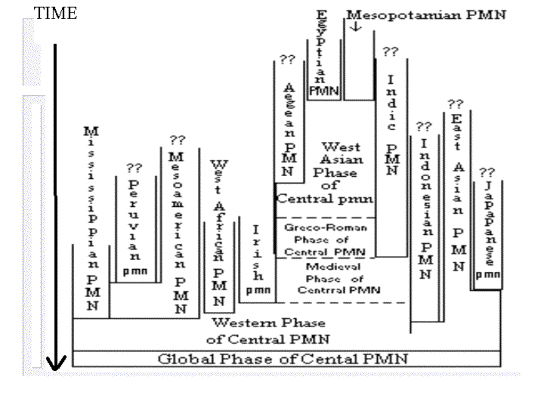
Figure
1: 5000 Year Emergence of the Central
System (adapted from Wilkinson 1987)
The processes of expansion and
increasing complexity have not produced a smooth upward trend in which the
originally less complex and hierarchical areas became increasingly more
complex. Rather social change has been characterized by uneven development in
both space and time. Original areas where leading edge developments have
emerged eventually lost out to new regions where unprecedented levels of
complexity and hierarchy developed. Temporal cycles of expansion and political
centralization were punctuated by occasional upward sweeps to new higher levels
– a stair-step pattern.
All hierarchical macrosystems, even
including those based on chiefdoms (Anderson 1994) and early states (Marcus 1998) experience
a sequence of the rise and fall of large polities – a cycle of
centralization and decentralization of political power. This is known in
state-based systems as the rise and fall of empires. In the modern macrosystem
of the last few centuries a similar (but also different) phenomenon can be seen
in the rise and fall of hegemonic core states such as Britain in the nineteenth
century and the United States in the twentieth century. Interaction networks also expand and
contract in a pattern that we can call pulsation. This expansion and
intensification of large interaction networks corresponds to one important
aspect of what is called “globalization” in the modern world-system. The recent wave of global trade and
investment integration since World War II was preceded by a globalization phase
during the last half of the nineteenth century that attained nearly the same
degree of worldwide connectedness (Chase-Dunn, Kawano and Brewer 2000).
These cyclical
processes (rise and fall; pulsation) must
be modeled in order to understand the more rare instances in which new
higher levels of integration and hierarchy have emerged. Both cities and
empires in Eastern and Western Asia have been found to grow and decline
synchronously from 500 BCE until 1500 CE, but South Asia did not follow this
pattern (Chase-Dunn, Manning and Hall 2000; Chase-Dunn and Manning 2002).
The four regional
intersocietal systems we propose to study before 1500 CE are: 1. West
Asia/Mediterranean; 2. East Asia; 3. South Asia; and 4. Central Asia. Except
for Central Asia we will focus on the settlement systems surrounding the
largest cities in each region. In Central Asia we will focus on cities and the
main areas inhabited by nomadic pastoralists. After 1500 CE we will study these
same regions plus Europe and the Americas.
The dynamics of agrarian states
The
primary resources in agrarian economies are land and people. Geopolitical
models, such as those developed by Randall Collins and Robert Hanneman (Collins 1995, Hanneman et al. 1995), postulate that state power is
directly related to the amount of territory and population that the state
controls. This functional dependence leads to positive-feedback dynamics: a
state that expands territory increases its power, which in turn enables it to
expand more, and so on (a classical example is the Roman expansion under the
late republic). However, eventually the ability of the state to extend its
territorial control becomes limited by the difficulty and expense of projecting
power across space. This connection between the state size and “logistical
loads” is sometimes referred to as the imperial
overstretch principle (Kennedy 1987).
Spatial
location is important
for explaining the geopolitical trajectories of states. Historians noticed long
ago that new, aggressive states that have an excellent chance to grow into a
large empire tend to arise on the marches (edges) of old empires (McNeill 1963). Within the comparative
world-systems perspective, this phenomenon is termed semiperipheral marcher conquest, in which a new state from out on
the edge of the circle of old states conquers all (or most) of the states in
the old core region to form a “universal empire” (Chase-Dunn and Hall 1997). The geopolitical theory explains
this empirical pattern by invoking the marchland
position principle: states with enemies on fewer fronts expand at the
expense of states surrounded by enemies (Collins 1995). However, a comprehensive empirical
test on the European material during the first two millennia CE indicates that
there is no statistical association between protected position of a region and
the size of polity emerging from it (Turchin 2003). An alternative explanation is
suggested by the observation that not all imperial marchlands or
semiperipheries give birth to aggressively growing polities. It appears that
incipient empires arise only in locations where pre-existing imperial
boundaries coincide with intense cultural, or ethnic, frontiers. During the
last two millennia the most common symbolic markers demarcating such metaethnic frontiers (the prefix meta indicates the intensity of ethnic
difference across the frontier) have been based on world religions (thus, the
most common variety in the European context are the Christian-Muslim
frontiers). Metaethnic frontiers are zones where groups come under enormous
pressure, and where ethnocide or even genocide, but also ethnogenesis, commonly
occur (Hall 2000). Intense intergroup competition
eventually results in one group with high internal cohesion absorbing other
ethnically similar groups, and in the process constructing the core of a rising
empire (Turchin 2003).
An
implicit assumption of the geopolitical model discussed above is that
geopolitical resources, land and people, come as a package. In reality,
however, the population of a state can grow (or decline) without corresponding
addition or loss of territory. Growing population density initially increases
geopolitical power of the state, because there are more taxpayers and recruits
for the army. However, population growth in excess of the productivity gains of
the land has deleterious effects on social institutions (Goldstone 1991). It leads to persistent price
inflation, falling real wages, rural misery, and urban migration; an increased
number of aspirants for elite positions and intense intra-elite competition;
and spiraling state expenses due to inflation and expanding real costs, since
armies and bureaucracies grow together with population. As all these trends
intensify, the state goes into bankruptcy and loses military control. Elite
movements of regional and national rebellion and a combination of
elite-mobilized and popular uprisings lead to the complete breakdown of central
authority (Goldstone 1991). In turn, state collapse and
ensuing sociopolitical instability cause higher death and emigration rates,
lower birth rates, and negative effects on the productive infrastructure such
as irrigation canals and flood-control dams.[1]
Models incorporating both the effect of population growth on state stability,
and the feedback from state instability to population decline suggest that we
should observe long-term demographic-political cycles, with periods of roughly
two-three centuries (Turchin 2003).
Theories of Rise and Fall
Complex
interchiefdom systems experienced a cycle in which a single paramount chiefdom
became hegemonic within a system of competing polities by conquering adjacent
chiefdoms (D.G. Anderson 1994; Kirch 1984).[2]
Once states emerged within a region they went through an analogous cycle of
rise and fall in which a single state became hegemonic and then declined.
Eventually most of these systems of states (interstate systems), experienced
the phenomenon of semiperipheral marcher conquest in which a new state
from out on the edge of the circle of old states conquered all (or most) of the
states in the old core region to form a “universal empire”.[3]
These
patterns repeated themselves in several world regions for thousands of years,
with occasional leaps in which a semiperipheral marcher state conquered larger
regions than had ever before been subjected to a single power (e.g. Assyrian Empire,
Achaemenid Persia, Alexandrian Empires, the Chin and Han Dynasties, Roman
Empire, the Islamic Caliphates, the Aztec and Inca Empires, the Manchu Dynasty
in China). During the Bronze and Iron Age expansions of the tributary empires a
new niche emerged for states that specialized in the carrying trade among the
empires and adjacent regions. These semiperipheral capitalist city states were
usually “thalassocratic” entities that
used naval power to protect sea-going trade (e.g. the Phoenician city-states,
Venice, Genoa, Malacca), but Assur on the Tigris, the “Old Assyrian city-state
and its colonies,” (Larsen 1976) was a land-based example of this phenomenon
that relied mainly upon donkey caravans for transportation. The semiperipheral
capitalist city-states did not typically conquer other states[4]
to construct large empires, but their trading and production activities
promoted regional commerce and the emergence of markets within and between the
tributary states.
With
the eventual rise of Europe and intensified capitalism a modification of the
old pattern of semiperipheral marcher conquest appeared. In the European
interstate system the semiperipheral marcher states were outdone by a new breed
of capitalist nation-states. These capitalist hegemons established primacy in
the larger system without conquering adjacent core states, and so the core
remained multicentric despite the continued rise and fall of hegemonic core
powers. Imperialism over adjacent states was reorganized as colonial empires in
which each core state had its own distant peripheral colonies – the European
domination of peoples in Africa, Asia and the Americas. The efforts by some
modern core powers to conquer their neighbors were defeated by coalitions that
sought to reproduce a multistate structure among core states. Thus the
oscillation between “universal state” and “interstate system” came to end and
was replaced by the rise and fall of hegemonic core powers. The hegemonic
sequence of the modern interstate system alternates between two structural
situations as hegemonic core powers rise and fall: hegemony and hegemonic
rivalry. This was the new form of the process of rise and fall.
The Westphalian
interstate system, in which the sovereignty of separate and competing states is
institutionalized by the right of states to make war to protect their
independence, has become a taken for granted institution in the modern
world-system. Historians of international relations (e.g. Kennedy 1987) and
theorists of international relations (e.g. Waltz 1979) have come to define this
situation as a natural state of being. Authors with greater temporal depth
(e.g. Wilkinson 1988, 1999) have argued that the peculiar resistance of the
modern interstate system to the emergence of a universal state by means of conquest
has been the result of an evolutionary learning process unique to modern Europe
in which states realized that in order to protect their own sovereignty they
should band together and engage in “general war” whenever a “rogue state”
threatens to conquer another state.
A
rather different explanation of the modern transition from the pattern of
semiperipheral marcher state conquest to the rise and fall of hegemonic core
powers points to the emergent predominance of capitalist accumulation in the
European-centered interstate system.
Once capitalism had become the predominant strategy for the accumulation
of wealth and power it partially supplanted the geopolitical logic of
institutionalized political coercion as a means to accumulation. Powerful capitalist
core states emerged that could effectively prevent semiperipheral marcher
states from conquering whole core regions to erect a “universal state.” The
first capitalist-nation state to successfully do this was the Dutch republic of
the seventeenth century.
There
are several important ways in which explanations of modern rise and fall are
different from one another. One important distinction is between the
functionalists (who see emergent global hierarchies as serving a “need for global
order,”) and conflict theorists (who dwell more intently on the ways in which
hierarchies serve the privileged, the powerful and the wealthy). The term
“hegemony” usually corresponds with the conflict approach, while the
functionalists tend to employ the idea of “leadership,” though several analysts
occasionally use both of these terms (e.g. Arrighi and Silver 1999). Another
difference is between those who stress the importance of political/military
power vs. what we shall call “economic power.” This issue is confused by
disciplinary traditions (e.g. differences between economics, political science
and sociology). Most economists entirely reject the notion of economic power,
assuming that market exchanges occur among equals. Most political scientists and
sociologists would agree that economic power has become more important than it
formerly was. Some of the literature on
recent globalization goes so far as to argue that states and military
organizations have been largely subsumed by the power of transnational
corporations and global market dynamics (e.g. Ross 1995).
The three most important approaches to theorizing modern
hegemony are those of Wallerstein (1984, 2002), Modelski and Thompson (1994);
and Arrighi (1994). Wallerstein defines hegemony as comparative advantages in
profitable types of production. This economic advantage is what serves as the
basis of the hegemon’s political and cultural influence and military power.
Hegemonic production is the most profitable kind of core production, and hegemony
is just the top end of the global hierarchy that constitutes the modern
core/periphery division of labor. Hegemonies are unstable and tend to devolve
into hegemonic rivalry.
Wallerstein
sees a Dutch seventeenth century hegemony, a British hegemony in the nineteenth
century and U.S. hegemony in the twentieth century. He perceives three stages within each hegemony. The first is
based on success in the production of consumer goods; the second is a matter of
success in the production of capital goods; and the third is rooted in success
in financial services and foreign investment stemming from the
institutionalized centrality of the hegemon in the larger world-system.
George Modelski and William R.
Thompson (1994) contend that the world needs order, and world powers rise to
fill this need. Such powers rise on the
basis of economic comparative advantage in newly leading industries, which
allow them to acquire the resources needed to win wars among the great powers
and to mobilize coalitions that keep the peace. World wars are the arbiters
that function as selection mechanisms for global leadership. But the comparative advantages of the
leaders diffuse to competitors and new challengers emerge. Successful challengers
are those that ally with the declining world leader against another challenger
(e.g. the U.S. and Britain against Germany).
Giovanni
Arrighi’s (1994) The Long Twentieth Century employs a Braudelian
approach to the analysis of what he terms “systemic cycles of accumulation.”
Arrighi sees hegemonies as successful collaborations between finance
capitalists and wielders of state power. His tour of the hegemonies begins with
Genoese financiers who allied with Spanish and Portuguese statesmen to perform
the role of hegemon in the fifteenth century. In Arrighi’s approach the role of
hegemon itself evolves, becoming more deeply entwined with the organizational
and economic institutional spheres that allow for successful capitalist
accumulation. He sees a Dutch hegemony of the seventeenth century, then a
period of contention between Britain and France in the eighteenth century, and
a British hegemony in the nineteenth century, followed by U.S. hegemony in the
twentieth century.
A
distinctive element of Arrighi’s approach is his contention that profit making
from trade and production becomes less profitable toward the end of a ‘systemic
cycle of accumulation” and so big capital increasingly focuses on financial
manipulations. Arrighi’s approach is
compatible with the idea that new lead industries are important for the rise of
a hegemon, but he sees the economic activities of big capital during the
declining years in terms of speculative financial activities. These latter
often correspond with a period of “growth” in which incomes are rising during a
latter-day belle époque of the systemic cycle of accumulation. But this
period of accumulation is based on the economic power of haute finance
and the centering of world markets in the global cities of the hegemons rather
than on their ability to produce real products that people will buy, and so
these belle époques are unsustainable bubbles that are followed by
decline.
The
main task of the proposed project will be to develop dynamical models of the
rise and fall of states and the occasional upward sweeps in which newly
emergent states break through the extant ceiling of state size to produce a
much larger polity than has ever existed before (See Figure 2). We will begin
with a demographic and ecological model of the growth and decline of land-based
“tellurocratic” states. Then we will develop a model of the growth of
“thalassocratic” maritime capitalist city-states. These models will then be
combined to model the transition to the “modern” pattern of the rise and fall
of capitalist hegemonic nation-states.
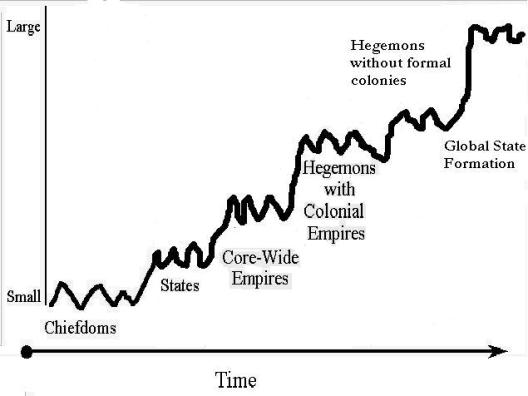
Figure 2: Rise and Fall with Upward Sweeps of State
Size
The basic model
Figure
3 (below) illustrates our several hypotheses about the causal relations among the main variables that cause
city and empire growth. At the top of Figure 3 is Population Growth. Procreation is socially regulated in all human
societies, but despite this there has been a long-run tendency for population
to grow. Population Growth leads to Intensification,
defined by Marvin Harris (1977:5) as “the investment of more soil, water,
minerals, or energy per unit of time or area.”
Intensification leads to Environmental
Degradation as raw material inputs become scarcer and the unwanted
byproducts of human activity (pollution, etc.) modify the surrounding
environment. Together Intensification and Environmental Degradation lead to
rising costs in terms of labor time needed to produce the food and raw
materials that people need, and this condition is called Population Pressure. In order to feed more people, farmers must use more marginal land
because the best soils have become degraded. Or deer hunters must travel father
to find their quarry once deer have become depleted in nearby districts. Thus
the cost in time and effort of producing a given amount of food increases
(Boserup 1965; 1981). Some resources are less subject to depletion than others
(e.g. fish compared to big game), but increased use usually causes rising
costs. Other types of environmental degradation are due to the side effects of
production, such as the build-up of wastes and pollution of water sources.
These also increase the costs of continued production or cause other problems.
As long as there were available
lands to occupy, the consequences of population pressure led to Migration. And so humans populated the
whole Earth. The costs of Migration
are a function of the availability of desirable alternative locations, moving
costs, and the effective resistance to immigration that is mounted by those who
already live in these alternative locations.
Circumscription (Carneiro 1970) occurs when
the costs of leaving are higher than the costs of staying. This is a function
of available lands, but lands are differentially desirable depending on the
technologies that the migrants employ. Generally people have preferred to live
in the way that they have lived in the past, but Population Pressure or other push factors can cause them to adopt
new technologies in order to occupy new lands.
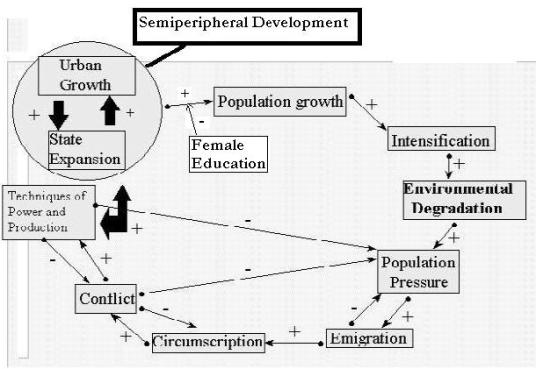
Figure 3: Demographic and Environmental Causes of City
and State Growth[5]
The factor of resistance from extant occupants is also a complex
matter of similarities and differences in technology, social organization and
military techniques between the occupants and the groups seeking to immigrate. Circumscription increases the
likelihood of higher levels of Conflict in
a situation of Population Pressure
because, though the costs of staying are great, the exit option is closed
off. This can lead to several different
kinds of warfare, but also to increasing intrasocietal struggles and conflicts
(civil war, class antagonisms, etc.) A
period of intense conflict tends to reduce Population
Pressure if significant numbers of people are killed off. And some systems
get stuck in a vicious cycle in which warfare and other forms of conflict
operate as a demographic regulator, e.g. the Marquesas Islands (Kirch 1991).
This cycle corresponds to the path that goes from Population Pressure to Migration
to Circumscription to Conflict, and then a negative arrow
back to Population Pressure. When
population again builds up another round of heightened conflict knocks it back
down again..
Under
the right conditions a circumscribed situation in which the level of conflict
has been high will be the locus of the emergence of more hierarchical
institutions, larger states and larger cities. Carneiro (1970) and Mann (1986)
contend that people will tend to run away from state-formation if they can in
order to maintain autonomy and equality. But circumscription prevents exit, and
exhaustion from prolonged or extreme conflict may make subservience to a new
state the least bad alternative. It is often better to accept a king than to
continue fighting. And so kings (and big men, chiefs and emperors) emerged out
of situations in which conflict had reduced the resistance to centralized power.
This is quite different from the usual portrayal of those who hold to the
functional theory of stratification.
The world-system insight here is that the newly emergent elites most
often come from regions that have been semiperipheral. These larger states
build new or expand existing cities.
Intersocietal systems
are often structured as hierarchies in which powerful core states dominate
and/or exploit less powerful semiperipheral and peripheral peoples. And yet
some semiperipheral agents of change are unusually able to put together
effective campaigns for erecting new levels of hierarchy.[6]
This may involve both innovations in the “techniques of power” and innovations
in productive technology (Technological
Change). Newly emergent elites often implement new production technologies
as well as new waves of intensification. This, along with the more peaceful
regulation of access to resources organized by the new elites, creates the
conditions for a new round of Population
Growth, which brings us around to the top of Figure 3 again. Female
education and involvement in the world of work outside the household lowers the
birth rate, and many countries in the contemporary world have stable population
sizes, but the world as a whole has not yet reached that point and so the
iteration model is still working. At some humans are likely to reach a stable
population maximum, and the iteration model will need to be greatly modified to
explain subsequent development.
The emergence of
regional market exchange and states specializing in trade articulate changes in
intensification, environmental degradation and population pressure with
technological change, and so the mechanisms at the bottom of the model in
Figure 2 are by-passed at least temporarily until population growth is so great
that these articulations are overwhelmed. Then the process once again shifts
toward greater conflict.
City growth. The growth of cities, a major component of
the anthropogenic built environment, is affected by multiple factors. One important factor is demographic
change. In the agrarian era cities were
population sinks, and relied on immigration from rural areas to sustain
themselves. Rural population growth exacerbated this “sink” effect. When rural
population increased beyond a certain threshold, rural areas suffered from an
excess of labor, prompting migration to the cities. Such periods were usually
accompanied by a flowering of crafts, because labor was cheap, and elites,
enjoying greater returns from agriculture (due to high rents) tended to spend
some of their wealth on the products of artisan labor. On the other hand, low
real wages meant that an increasing proportion of the urban population was
living below the subsistence level. As a result, urban mortality rates tended
to rise, and birth rates to decline.
Another important factor affecting city growth is technological
development, which leads to greater agricultural productivity and a larger
proportion of population living in the cities.
Improvements in sanitation and health did not greatly affect the urban
mortality rate until the middle of the nineteenth century.
Imperial expansion. So far we have addressed the nonspatial aspects of the modeled
system – either acting in a
local fashion (population growth, agricultural intensification) or, conversely,
in a global fashion (global climate change, millennial growth of technological
knowledge). What makes a model explicitly spatial, however, are processes that
connect various localities, and whose strength declines with distance. One such
mechanism is the spatial expansion of empires resulting from conquest of
adjacent territories. The first, and obvious, factor is the size of the
population controlled by the empire. However, the effect of population size on
military strength is nonlinear. One of
the important factors affecting imperial conquest is the strength of the state
(S), since wealthy empires can raise
large armies, purchase expensive equipment, and sustain armies in the field for
lengthy periods of time. Thus, an empire during the unfavorable phase of the
demographic cycle (when it suffers from fiscal crisis) has great difficulties
in financing war operations. These are periods when empires are extremely
vulnerable to adversary empires, or to barbarians. Other mechanisms affecting
warfare that we will investigate are changes in military technology and the
military advantages of developed by Central Asian steppe nomads during a long
period within the project time frame.
An important spatial process affecting imperial growth is the
logistical aspect of the ability of the state to project its power over
distance. This theory has been well developed as a result of work by Randall
Collins (1999) on geopolitics (see also Hanneman 1995 and Turchin 2003b). We
will model geopolitical processes by focusing on spatial units located on or
near the boundary between adjacent states, and calculating the power that each
state can bring to bear on these spaces. In the simplest formulation, the power
of State 1 delivered to square with coordinate x,y is:
P1(x,y,t) = S1 exp[-d1(x,y)/h]
where S1 is the resources of State
1 and d1 is the distance
from the center of State 1 to the spatial unit x,y. Parameter h
modulates how fast power diminishes with distance (and its units are km). P2(x,y,t) is calculated
analogously. The relative values of P1
and P2 determine whether
State 1 or State 2 will conquer the unit. For example, a simple rule is that
the probability of the square going to State1 is equal to P1/(P1+P2), and vice versa.
The logistics parameter h
can be made a function of the local geography. It is easier to project power
across flat space than across mountains. We will also investigate the effect of
a multiplier that will reflect the military technology available to each state,
or reflect the difference between, say, nomads and settled polities.
Core/periphery status. Examination of the hypothesis that semiperipheral societies
are frequently the loci of change agents that expand and transform
institutional structures will require coding the position of societies in
core/periphery hierarchies. Fortunately David Wilkinson (1991) has already
produced a coding of sedentary societies into core, peripheral and
semiperipheral categories. Our plan is to improve upon Wilkinson’s work by
distinguishing between different kinds of semiperipheries and by including
nomadic peoples.
Causes of East/West
Synchrony
One important product of our modeling
project will be to determine the causes of a fascinating synchrony that emerged
between East Asia and the distant West Asian/Mediterranean region in the
growth/decline phases of cities and empires, but did not involve the
intermediate South Asian region. Studies have used data on both city sizes and
the territorial sizes of empires to examine the hypothesis that regions distant
from one another were experiencing synchronous cycles of growth and decline
(e.g. Chase-Dunn, Manning and Hall 2000; Chase-Dunn and Manning 2002). Frederick Teggart’s (1939) path-breaking world historical study
of temporal correlations between events on the edges of the Roman and Han
Empires argued the thesis that incursions by Central Asian steppe nomads were
the key to East/West synchrony. A study of city-size distributions in
Afroeurasia (Chase-Dunn and Willard 1993; see also Chase-Dunn and Hall 1997:
222-223) found an apparent synchrony between changes in city size distributions
and the growth of largest cities in East Asia and West Asia-North Africa over
the period from 500 BCE to 1500 CE. That
finding led to a study of the territorial sizes of empires, which found a
similar synchrony (Chase-Dunn, Manning and Hall 1999). [7]
Plausible causes of these synchronies are climate change, epidemics, trade
cycles, and the incursions of Central Asian steppe nomads.
Global State Formation
The scientific literature on future
global state formation has mainly consisted of linear or quadratic
extrapolations of several different cross-temporal empirical indicators. Robert
Carneiro’s (1978) original study quantified the long-term decline in the number
of autonomous polities on Earth to predict an emergent world state in about
1000 years from the present. Earlier studies by Raul Naroll (1967) and Louis
Marano (1973) had used the territorial sizes of states for a similar purpose.
Peter Peregrine, Melvin Ember and Carol R. Ember (2004) employ a similar
extrapolation approach that uses indicators based on codings of archaeological
evidence. Based on an indicated
quadratic curve over the past 12,000 years, they predict the emergence of a
global state by CE 5000.
The
careful study of the territorial sizes of the largest empires over the past
3000 years by Rein Taagepera (1978, 1997) shows that the largest states in
different regions tended to rise and fall with occasional radical upward
swings. Taagepera observes that the median duration of large polities at more
than half their peak size has been around 130 years. He also notes that
polities that expand fast are somewhat shorter-lived than polities that expand
more slowly. And he reports that three sudden increases in polity sizes
occurred around 3000 BCE, 600 BCE and CE 1600. [8]
Upward Sweeps
The
question of the timing of upward sweeps to new levels is entirely germane to
the problem of modeling global state formation. So also is the issue of how
unusually large states have been formed in the past. Upward sweeps have mainly
been instances of a semiperipheral marcher state conquering and unifying
adjacent older core states and nearby peripheral areas. So conquest has been
the main mechanism of large-scale political integration. But the pattern of
hegemonic rise and fall in the modern world-system has been different. The most
powerful states, the hegemons (the Dutch, the British and the United States),
have fought semiperipheral challengers (e.g. Napoleonic France and Germany) to
prevent the emergence of a core-wide empire. We contend that this is because
the hegemons are the most capitalist states in the system, the ones for whom
economic success is most closely tied to the ability to make superprofits on the
technological rents that return from new lead technologies.
Only during hegemonic decline have
the modern capitalist hegemons shown a tendency toward “imperial overreach” in
which their military power is employed in a last ditch effort to prop up a
declining economic hegemony. These efforts have not been successful, and a new
hegemon only emerges after a period of hegemonic rivalry and world war. This is
a method of choosing “global leadership” that we can no longer afford to
employ, and so the issue of institutions that can peacefully resolve the
struggle for hegemony is of the first importance for our very survival as a
species.
The
approach that we propose is to model the main causes of state formation and
upward sweeps taking into account the ways in which the basic processes have
been altered by the emergence of new institutions. We will elaborate and improve upon the recent work of Robert
Bates Graber (2004). Graber develops
both an ahistorical and an historical population pressure model of political
integration. His ahistorical model is a very simplified version of the
iteration model displayed in Figure 3 above that includes population growth
rates and the number of independent polities. Graber’s historical model takes
account of the emergence of the League of Nations and the United Nations as our
approach will do. But we add the rise and fall cycle, the emergence of markets
and capitalism, and the growth of other international political organizations
and non-governmental organizations to our model of political globalization.
The
main political structure of the modern world-system has been, and remains, the
international system of states as theorized and constituted in the Peace of
Westphalia. This international system of competing and allying national states
was extended to the periphery of the modern world-system in two large waves of
decolonization of the colonial empires of core powers. The modern system
already differed from earlier imperial systems in that its core remained
multicentric rather than being occasionally conquered and turned into a
core-wide empire. Instead, empires were organized as distant peripheral
colonies rather than as conquered adjacent territories. Earlier instances of
this type of colonial empire were produced by thallasocratic states, mainly
semiperipheral capitalist city-states that specialized in trade. In the modern
system this form of colonial empire became the norm, and the European core
states rose to global hegemony by conquering and colonizing the Americas, Asia
and Africa in a series of expansions (see Figure 4). The international system
of sovereign states was extended to the colonized periphery in two large waves
of decolonization (see Figure 4). After a long-term trend in which the number
of independent states on Earth had been decreasing, that number rose again with
decolonization and the core states decreased in size when they lost their
colonial empires.
Extension of the
State System to the Periphery
The
decolonization waves were part of the formation of a global polity of states.
And one of the decolonized regions became “the first new nation,” and
eventually rose to hegemony to become the largest hegemon the modern system has
seen – the United States. The doctrine
of the national self-determination, long a principle of the European state
system, was extended to the periphery.
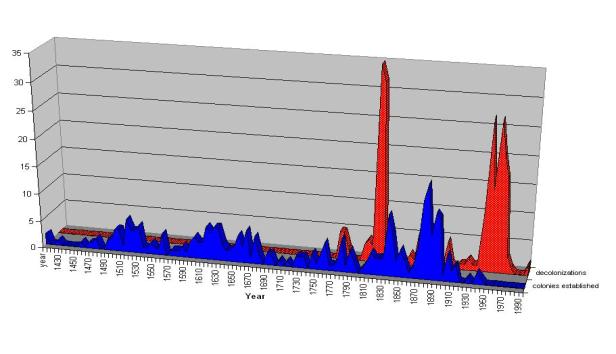
Figure 4: Waves of colonization and decolonization
based on Henige (1970)
This multistate system has also
experienced waves of international political integration that began after the
Napoleonic Wars early in the nineteenth century. Britain organized a “Concert
of Europe” (Jervis 1985) that was intended to prevent future French revolutions
and Napoleonic adventures. During the middle of the nineteenth century a large
number of specialized international organizations emerged such as the
International Postal Union (Murphy 1994) that underwrote the beginnings of a
global civil society that included more than elites, and this network of
transnational voluntary associations grew much larger during the most recent
wave of economic globalization since World War II. After World War I the League of Nations was intended to provide
collective security, though it was weakened by the failure of the United States
to join. After World War II the United Nations became a proto-world-state, the
efficacy of which has waned and waxed since then. The system of national states
is being slowly overlain by global and regional transnational political
organizations that blossom after periods of war and during periods of economic
globalization.
Our
historical model will add marketization, decolonization, new lead technologies,
the rise and fall of hegemons, and the rise of international political
organizations to the population pressure model in order to forecast future
trajectories of global state formation. And we will assemble empirical data for
the last two hundred years on the trend toward global political integration in
order to parameterize our models. This will allow us to examine how changing assumptions
about the relationships among variables will affect probable future
trajectories of international political integration. Our conceptualization of
the cyclical nature of many processes will allow us to consider how downward
plunges and possible collapses might affect the probable trajectories of global
state formation.
We
will also take into account the structural differences between recent and
earlier periods. For example, the period of British hegemonic decline moved
rather quickly toward conflictive hegemonic rivalry because economic
competitors such as Germany were able to develop powerful military
capabilities. The U.S. hegemony has been different in that the United States
ended up as the single superpower after the decline of the Soviet Union.
Economic challengers (Japan and Germany) cannot easily use the military card
because they are stuck with the consequences of having lost the last World War.
This, and the immense size of the U.S. economy, will probably slow the process
of hegemonic decline down relative to the speed of the British decline
(Chase-Dunn, Jorgensen, Reifer and Lio, Forthcoming). [9]
Our
modeling of the global future will also consider changes that have occurred in
labor relations, urban-rural relations, the nature of emergent city regions,
and the shrinking of the global reserve army of labor (Silver 2003).
TheTrajectory of Political Globalization
We
conceptualize political globalization analogously to our understanding of
economic globalization as the relative strength and density of larger versus
smaller interaction networks and organizational structures. Much has been written about the emergence
and development of global governance and many see an uneven and halting upward
trend in the transitions from the Concert of Europe to the League of Nations
and the United Nations toward the formation of a proto-world state. The
emergence of the Bretton Woods institutions (the International Monetary Fund
and the World Bank) and the more recent restructuring of the General Agreement
of Tariffs and Trade as the World Trade Organization, and the visibility of
other international fora (the Trilateral Commission, The Group of Seven
[Eight]; the World Economic Forum, the World Social Forum meetings, etc.)
support the idea of emerging global governance. The geometric growth of international non-governmental
organizations (INGOs) is also an important phenomenon of global governance and
the emergence of global civil society (Murphy 1994; Boli and Thomas 1999).
As
we have discussed above, all world-systems go through cycles of political
centralization and decentralization with occasional leaps toward new and higher
levels of political integration (Chase-Dunn and Hall 1997). In the modern
world-system the cycle for the last 400 years has taken the form of the rise
and fall of hegemonic core states. Some claim that the hegemonic sequence is now morphing into a new structure of core
condominium (Goldfrank 1999). We intend
to study both the hegemonic sequence and emerging global governance. While
these might be combined into a more general concept of political globalization,
we contend that it is important to keep them separate because hegemonic rise
and fall is an old feature of the world-system, whereas political globalization
is arguably much more recent. Political
globalization can be analytically reduced to the question of the relative
strength of larger vs. smaller political and military organizations (including
also the functionally “economic” ones (IMF, World Bank, WTO) mentioned above.[10]
Data Development,
Measurement Strategies and Units of Analysis
This project will develop a World
Historical System Time Map using an optimalized Afroeurasian cartographic grid
that includes the focal regions we are studying. We will establish an Internet
Collaboratory website. This will enable us to share access to the joint
products of our research and to update modeling and data enhancements easily
with all the project participants.
The project will develop programs to
directly link the spatio-temporal database with our simulation models and
statistical analyses, and to move modeling results back into the
spatio-temporal format for visualization of modeling results. We will produce a
relational database that is in an interoperable format to be linked with
digital gazetteers and libraries such as the Alexandria Digital Library and the
Electronic Cultural Atlas Initiative.
The basic strategy is to use
statistical analyses of urban growth and changes in the territorial size of
empires over the last three thousand years to parameterize our models. This
will involve utilizing and extending three existing compilations of data:
Tertius Chandler's (1987) Four Thousand Years of Urban Growth, George
Modelski’s (2003) World Cities, -3000-2000 and Rein Taagepera's (1978a;
1978b; 1979; 1986; 1997) studies of the territorial sizes of empires.
We have developed a plan for
enhancing these datasets on city populations and locations, the territorial
sizes and geographical boundaries of states and empires, power configurations
of interstate systems, climate change indicators, warfare, trade fluctuations,
migrations and incursions. Using these data we will construct several different
kinds of measures (e.g. city size distributions, empires size distributions)
and will utilize sophisticated methods for splicing earlier, poorer indicators
with later, better ones.
Units of Analysis
Our spatio-temporal database will code the locations
of events, settlements, polity boundaries, wars, epidemics and climate change
indicators. We will use three different approaches to the problem of units of
comparison for our statistical analyses:
1.
single
states;
2.
political/military
networks (which change their sizes over time because of expansion),
3.
and
constant regions (East Asia; South Asia, Central Asia; West Asia/Mediterranean;
and (after 500 BP) North and South America.
Using both political/military
networks (2) and constant regions (3) will allow us to crosscheck our results
to see if our way of bounding “cases” affects inferences about causal
relations.
Model Testing
We plan to test portions of our models using
structural equations modeling (SEM) and path analysis. Our data sets will have
a pooled-cross-section and time-series (panel) structure that can be used for
the estimation of structural equation models.
For example, a city’s population size at any t+1 will be modeled
as a linear additive function of its size at t, plus the magnitude of
trade inflows to the city at t, and the political centrality of the city
at t. The error structures of
such models are relatively complex, owing to both the pooled cross-sectional
and time-series design, and to the geographical or network embeddedness of
cases, but econometric modeling approaches to such problems are well
understood. We will test hypotheses about the causes of rise/fall and synchrony
with multiple time series analysis across PMNs and regions with attention to
the need to detrend variables and problems of temporal autocorrelation.
There is a single size distribution of political/military
organizations in the modern world-system. We will operationalize three
different parts of this size distribution, as well as the whole thing. Our conceptualization of political
globalization will be analogous to our understanding of economic globalization
– a ratio of the size and importance of global and international organizations
vs. the sum of size and importance of national (and multinational) states. But we will also operationalize the
hegemonic sequence by examining changes in the distribution of economic and
military power among the core states using the research of Modelski and
Thompson (1996). And we will study the
changing shape of the whole system of states as well, taking into account the
processes of colonization and decolonization (Bergesen and Schoenberg 1980),
the incorporation of the peripheral and semiperipheral regions into the
interstate system, and changes in the distribution of economic and
political/military power in the whole system of states. We will also combine political globalization,
hegemonic rise and fall, and state power stratification into a single overall
measure of the distribution of power among state and proto-state institutions.
This latter we will call “overall global political/military inequality.”
Education Activities
Involvement
in this project will provide to graduate and undergraduate participants an
advancement of learning in both an individual and a social sense, and will
encourage the students to become generalists with a capacity to conduct their own
research as well as to move easily into more advanced doctoral or professional
study of global processes. We will
train the graduate and undergraduates working on this research project to do
interdisciplinary non-linear modeling and comparative research. They will be
exposed to the process of solving problems and moving research forward by being
involved in the weekly meetings conducted with the PIs and other advisors who
play a part in the project. Students will gain interdisciplinary data analysis
and modeling skills and will be encouraged to collaborate in the writing and
presentation of scholarly research papers for professional meetings and the
development of web-accessible materials stemming from our project.
Though
a major effort will be devoted to building and testing mathematical models, this project will also upgrade existing data
on key measures on the World Historical System Time Map.[11]
This refreshed spatio-temporal relational database will be used to produce
interpretive maps of the emergence of cultural complexity for high school and
college classes. Our data base
construction and model building will benefit from the collaboration of GIS
scientists from Environmental Sciences Research Institute (ESRI), a private
industry developer of GIS software and provider of spatial analyses in
Redlands, California. Graduate research assistants from our project will be
encouraged to participate in summer internships at ESRI.
A
key element of this project is the development and publication of an educational
web site based on our research and teaching. We will produce and make available
to the world community an educational resource that contains products from our
project that have been rewritten for use in high school and college courses.
The title of this educational web site will be “Human Social Dynamics,
Globalization and World State Formation.” This will include syllabi for
interdisciplinary global studies courses, graphical representations of our data
and modeling results, numerical geochronological datasets for use by students
for statistical analyses, and working papers produced by our project. We will
use the results of our data collection and analyses, and our World Historical
System Time Map to produce animated maps of Afroeurasia and the Americas for
presentation on our educational web site.
These will show where cities and empires rose and fell over the past
3000 years, how climate changed, and the emergence of trade routes, information
flows, and warfare interactions and alliances. Our education web site will have
versions in English, French, Mandarin, Russian and Spanish; and the graphical
presentations will be of use to teachers all over the world. These will be available for use in high
school world history and global history courses as well as in college courses
on environmental history, global studies, climate change, human ecology,
comparative civilizations, social evolution, and geography.
Management Plan
Realizing
our model-building goals will require a concentrated and coordinated effort in
collaboration with the data infrastructure effort. Assemblage of an integrated
geo-chronological database will involve a great deal of coordinated labor. The
Internet Collaboratory website will enable us to coordinate our efforts and to
share access to the joint products of our research with our senior advisors and
student researchers. Statistical
analyses to test causal propositions and fully operational complex models will
be achieved only after a considerable amount of prior work, and will depend on
the development of an interoperable knowledge system of spatially and
chronologically tagged information, the World Historical System Time Map
(WHSTM).
The
co-Principal Investigators are Christopher Chase-Dunn (Sociology, UCR), E.N.
Anderson (Anthropology, UCR) and Peter Turchin (Ecology and Evolutionary
Biology, University of Connecticut).
Chase-Dunn will carry out the overall administration of the project
(with grants management help at UC Riverside). He will oversee the project’s
Internet Collaboratory, and modeling of the causes of synchrony. Anderson will
coordinate the enhancement of datasets and the development of the World
Historical Systems Time Map. Turchin will build non-linear dynamic
spatio-temporal mathematical models of the historical dynamics of state growth
and decline, rise and fall, and upward sweeps in interstate systems. The project has 18 Advisors from
the United States and China (see below).
The Co-PIS at UC-Riverside and the
University of Connecticut will oversee graduate and undergraduate research
assistants. The evaluations of the project activities will be done by project
participants in interaction with students and colleagues attending professional
conferences until the final year. At the final working conference five experts
in dynamical modeling and macrohistorical social science who have not
participated in the project will prepare critiques of the penultimate version
of our models for presentation at the conference.
Advisors
Robert Carneiro
(American Museum of Natural History)
Claudio Cioffi (Computational Social
Science, George Mason University)
Roland Fletcher (Anthropology,
University of Sydney)
Robert Hanneman (Sociology, UCR)
Jack Goldstone (Sociology, George
Mason University)
Thomas D. Hall (DePauw
University)
Wang Jun, Beijing, (National Academy
of Geography, Beijing)
David Kowalewski (Political Science,
Alfred University)
Bai-lian Li (Botany and Plant
Sciences, UCR)
Craig Murphy (Political Science,
Wellesley College)
Jenny Pournelle, (Silk Road Project)
William I. Robinson (Sociology,
University of California-Santa Barbara)
Rein Taagepera, (Political Science,
University of California-Irvine)
Peter J. Taylor, (University of
Loughborough)
William R. Thompson (Political
Science, Indiana University)
Pao K. Wang (Atmospheric and Oceanic
Sciences, University of Wisconsin-Madison)
David Wilkinson (Political Science,
UCLA)
Zhiqian Yu: (ESRI, Redlands)
Work Plan
1st year
(October 2005-September 2006)
Organize and implement coordination
and communication among principal investigators and advisors. Begin weekly
Project Meetings at UC, Riverside. Set up the Internet Collaboratory for
the research project. Hire and train undergraduate and graduate research
assistants.
Ø Data: Establish standards: spatial
notations, time, location, and resolution.
Develop coding protocols for city, empire, core/periphery status and
climate change data. Develop separate bibliographies for city sizes, empire sizes
and climate change information. Systematically search libraries at the
University of California and the University of Connecticut, and Interlibrary
Loan Collections. Begin search and acquisition of climate change databases.
Develop specialized search engine software for digital data acquisition from
JSTOR and other digitized databases. Develop separate initial databases using
easily obtained information for city sizes, empire sizes, climate change,
warfare, trade, and migrations. Merge the already-coded city, empire and
climate change data in a prototype of the integrated geochronological database
(WHSTM1). Fine-tune design of the database. Locate significant gaps in the data. Make a plan for efficiently
filling them given resource constraints. Work on nesting, linking problems and
develop connections with interoperable on-line geocoded digital libraries.
Coordinate this with TimeMap®, ADEPT and ECAI.
Ø
Software:
Acquire and customize state-of-the-art spatiotemporal relational database and
network analysis software.
Ø
Model
Development: Fine-tune the overall modeling plan with feedback from all
participants. Develop modeling
standards. Acquire existing models. Formulate base models. Create simple
regional models (limited time-frames, limited numbers of variables). Arrange
all components in a format where they can communicate with one another. Redo
existing models for our purposes. Work on parameters, initial values. Get them
running separately. Figure out how to couple them. Work on nesting, linking
problems and further develop connections with GIS. Report on revision of
prototypes to incorporate emerging models and interoperability considerations.
Develop prototype complex causal models of macrosocial processes in interaction
with the environment.
Ø
Education:
Develop interdisciplinary courses on World Historical Systems and the
Environment. Send graduate research
assistants from our project to participate in summer GIS internships at ESRI in
Redlands, California.
2nd year
(October 2006-September 2007)
January Working Conference
at University of California-Riverside
Ø Data:
Develop the mechanism for updating and cross-linking data bases. Work on
filling in gaps, splicing series, generating statistics that can be input into
statistical analyses. Compare different approaches to interpolation and
uncertainty management. Produce WHSTM2.
Ø Analyses: Examine the interactions
within regions among urbanization, empire formation and climate change. Examine
the hypothesis of cross regional synchronization of city and empire
growth/decline phases with the WHSTM2.
Ø
Education:
Give interdisciplinary courses. Establish educational web site on
“Globalization and the Environment.” Involve students in research, teaching,
publications and conferences.
Ø
3rd year (October
2007-September 2008)
v latest versions of models;
v penultimate version of WHSTM;
v the results of statistical analysis
of the integrated database.
Revise or fine-tune the data model,
the resulting database and the analyses taking criticisms and suggestions from
advisors into account. Revise models taking criticisms and suggestions into
account. Produce final models.
Ø Model Development: Reparameterize
complex models with WHSTM2. Further refine the models.
Ø Analyses: Develop a temporal
map-rendering engine and data quality visualizations for the animations. Use
preliminary data to test different causal propositions. Set up Structural
Equations Model (SEM) of causes of synchronization. Use completed data set to
test SEM models and to parameterize complex models. See if we still find
synchronization of city and empire growth decline phases 650 BCE to 1500 CE
using upgraded datasets. If so, test models of causation of this
synchronization using SEM.
Ø Education: Produce proto-types of
animated graphics for educational web site using WHSTM2. Develop
linguistic themes in Mandarin, French, Spanish and Russian using appropriate
civilizational place names. Continue courses and student involvement in
research. Publish final versions of our models. Put the WHSTM into most recent formats compatible with
Alexandria Digital Library and the Electronic Cultural Atlas Initiative.
Publish the final revised version of the World Historical System Time Map,
(now linked with data resources in other locations), final statistical datasets
and final versions of animated graphics on our educational web site,
“Globalization and World State Formation.”
Present papers at conferences. Write books and articles for publication.
Prepare project report for NSF.
Project Significance
The
three-year project will develop new mechanism-rich spatio-temporal models of state formation, rise and
fall and upward sweeps of state size. This
project will produce an integrated complex model of social change in
interaction with the environment that will provide a quantitative understanding
of the long-term dynamics of world historical development. The modeling and
data-gathering efforts will provide important scientific interpretations of the
long-run dynamics of interactions of the cultures and institutions developed by
humans with the natural environment. The World Historical System Time Map is a
geo-chronological database containing information on fundamentally important
variables in a standardized format for other researchers as well as for
teachers, students and decision makers. The project will produce and make
available to the world community, through the educational web site "Human
Social Dynamics, Globalization and World State Formation", an educational
resource that contains products that have been rewritten for use in high school
and college courses.
The
modeling of the dynamics of agrarian interaction networks will make it possible
to compare these with the global interaction network that has emerged in the
last two centuries in order to understand both the similarities and the
differences. The educational products of the project will help to inform the
next generation of scientists and world citizens about the patterns of social
evolution and their implications for future global governance and the
educational products of the project will help to inform scholars and students
about the patterns of social evolution and their implications for human life on
Earth in the coming decades. The products of this proposed effort will allow
scientists, citizens and policy-makers to better anticipate and confront
problems of sustainability and social conflict that are likely to emerge in the
21st century. The project of
global polity building will be informed by study of the conditions that will
influence probable future trajectories of world state formation.
References Cited:
Abu-Lughod,
Janet Lippman 1989 Before European Hegemony: The World System A.D.
1250-1350 New York:
Oxford University Press.
Arrighi,
Giovanni 1994 The Long Twentieth Century: Money, Power and the Origins of
Our Times. London:
Verso
Bairoch,
Paul 1988 Cities and Economic Development.
Chicago: University of Chicago
Press.
Barabási,
A.-L. 2002. Linked: The New Science of Networks. Cambridge, MA: Perseus
Publishing.
Barfield,
Thomas J. 1989. The Perilous Frontier: Nomadic Empires and China.
Cambridge,
MA: Basil Blackwell.
Bentley,
Jerry H. 1993. Old
World Encounters: Cross-Cultural Contacts and Exchanges in Pre-Modern
Times. Oxford:
Oxford University Press.
Bergesen,
Albert and Ronald Schoenberg 1980 “Long waves of colonial expansion and
contraction
1415-1969” Pp. 231-278 in Albert Bergesen (ed.) Studies of the Modern
World-System. New York: Academic Press
Boli, John
and George M. Thomas 1997 “World culture in the world polity,” American
Sociological Review
62,2:171-190 (April).
__________
(eds.)1999 Constructing World Culture:
International Nongovernmental Organizations
Since 1875.
Stanford: Stanford University Press.
Boserup,
Ester1981. Population and Technological Change. Chicago: University of
Chicago
Press.
Braudel,
Fernand 1979 The Perspective of the World. New York: Harper and Row.
Carneiro,
Robert L. 1978 “Political expansion as an expression of the principle of
competitive
exclusion,” Pp. 205-223 in Ronald Cohen and Elman R. Service
(eds.) Origins
of the State: The Anthropology of Political Evolution. Philadelphia:
Institute for the Study of Human Issues.
________
2004 “The political unification of the world: whether, when and how – some
speculations.”
Cross-Cultural Research 38,2:162-177 (May).
Chandler,
Tertius 1987 Four Thousand Years of Urban Growth. Edwin Mellen Press:
Lewiston/Queenston,
Lampeter.
Christopher Chase-Dunn. 1990
"World state formation: historical processes and
emergent
necessity" Political Geography Quarterly, 9,2: 108-30 (April).
http://irows.ucr.edu/papers/irows1.txt
Chase-Dunn, Christopher and Thomas D. Hall. 1997 Rise and Demise:Comparing
World-Systems Boulder,
CO.: Westview
Chase-Dunn, C. and E. Susan
Manning 2002 “City systems and world-systems: four
millennia
of city growth an decline.” Cross-Cultural Research 36,4:379-398.
Chase-Dunn,
Christopher, Yukio Kawano and Benjamin Brewer 2000 “Trade
globalization
since 1795: waves of integration in the world-system.”
American Sociological Review,
February.
Chase-Dunn, Christopher, Andrew
Jorgenson, Thomas E. Reifer and Shoon Lio Forthcoming. “The
trajectory
of the United States in the world-system,” Sociological Perspectives.
Christian, David 2004 Maps of
Time. Berkeley: University of California Press.
Collins, Randall 1999 Macrohistory:
Essays in the Sociology of the Long Run. Stanford, CA:
Stanford University Press
Denemark,
Robert, Jonathan Friedman, Barry K. Gills and George Modelski (eds.) 2000
World System History: the social
science of long-term change.
London:
Routledge.
Diamond,
Jared 2004 Collapse. New York: Viking
Fischer, David Hackett 1996 The
Great Wave: Price Revolutions and the Rhythm of
History. New
York: Oxford University Press.
Frank, Andre Gunder and Barry K.
Gills (eds.) 1993 The World System: Five Hundred
Years or
Five Thousand ? London: Routledge.
Review
15:3(Sum):335-72.
Friedman,
Jonathan and Michael Rowlands 1977 "Toward an epigenetic model of the
evolution
of 'civilization.'" Pp. 201-78 in J. Friedman and M. Rowlands (eds.)
The
Evolution of Social Systems. London:Duckworth.
Galloway, Patrick R. 1986
“Long-term fluctuations in climate and population in the
preindustrial
era.” Population and Development Review 12,1:1-24 (March).
Goldfrank, Walter L. 1999 “Beyond hegemony” in Volker Bornschier and
Christopher
Chase-Dunn (eds.) The Future of Global Conflict. London:
Sage.
Gimblett, Randy 2001 Integrating
Geographic Information Systems and Agent-Based
Modeling: Techniques for Simulating Social
and Ecological Processes New
York:
Oxford University Press.
Goldstone,
J. A. 1991. Revolution and rebellion in the Early Modern world. University of
California
Press, Berkeley, CA.
Graber,
Robert Bates 2004 “Is a world state just a matter of time?: a
population-pressure
alternative.” Cross-Cultural Research
38,2:147-161 (may).
Hanneman, Robert A. 1988-89 Computer
Assisted Theory Building. Beverly
Hills: Sage.
_________1995 "Discovering
Theory Dynamics by Computer Simulation:
Experiments
on State Legitimacy and Capitalist Imperialism." Pp. 1-46 in Peter
Marsden
(ed.) Sociological Methodology (with Randall Collins and Gabrielle
Mordt).
Hardt, Michael and Antonio Negri 2004 Multitude. New York: Penguin
Harris,
Marvin. 1977. Cannibals and Kings: The Origins of Cultures. New York:
Random House.
Henige,
David P. 1970 Colonial Governors from the Fifteenth Century to the Present.
Madison, WI.:
University of Wisconsin Press.
Hughes, Barry B. 1996 International
Futures: Choices in the Creation of a New World
Order. Boulder,
CO:Westview.
Jervis, Robert 1985 "From
Balance to Concert: A Study in International Security
Cooperation,"
World Politics 38,1: 58-79
Johnson, Allen W. and Timothy
Earle. 1987. The Evolution of Human Societies: From
Foraging
Group to Agrarian State. Stanford: Stanford University Press.
Johnson, Amber Lynn 2004 “ Why not
to expect a “world state.” Cross-Cultural Research
38,2: 119-132 (May).
Khaldun,
Ibn 1981 The Muqaddimah. Princeton: Princeton University Press.
Kirch, Patrick V. 1984 The Evolution of Polynesian
Chiefdoms. Cambridge: Cambridge
University Press.
_________ 1991 “Chiefship and competitive involution: the
Marquesas Islands of Eastern
Polynesia” Pp. 119-145 in Timothy Earle (ed.) Chiefdoms:
Power, Economy and Ideology.
Cambrdige: Cambridge University Press.
Kowalewski, David and Dean Hoover
1995 “The future world-system: a dynamic model”
World
Futures 44:263-285.
Larsen, Mogens Trolle 1976 The
Old Assyrian City-State and its Colonies. Copenhagen: Akademisk Forlag
Lattimore, Owen. 1940. Inner Asian
Frontiers of China. New York: American
Geographical Society, republished 1951, 2nd
ed. Boston: Beacon Press.
Li, B. L. and E. L. Charnov. 2001.
Diversity-stability relationships revisited: scaling rules for
biological
communities near equilibrium. Ecological Modelling, 140: 247-254.
Marano, Louis A 1973 “A
macrohistoric trend toward world government.” Behavior
Science
Notes 8,1, 35-39
Mann, Michael. 1986.
The sources of social power:
Volume I: A history of power
from
the
beginning to a.d. 1760.
Cambridge: Cambridge University
Press.
[ http://www.nisc.com/factsheets/memd.htm].
McNeill,
J.R. and William McNeill 2003 The Human Web. New York: Norton
Modelski,
George 2003 World Cities: –3000 to 2000. Washington, DC: Faros 2000
Modelski,
G., W. R. Thompson. 1996. Leading sectors and world powers: the co-evolution
of
global politics and economics. University of South Carolina Press, Columbia,
SC.
Murphy,
Craig 1994 International Organization and
Industrial Change: Global Governance
since 1850. New York: Oxford.
Naroll,
Raul 1967 “Imperial cycles and world order,” Peace Research Society: Papers,
VII,
Chicago Conference, 1967: 83-101.
O’Rourke,
Kevin H and Jeffrey G. Williamson 1999 Globalization and History: The
Evolution
of a 19th Century Atlantic Economy.
Cambridge, MA.: MIT Press.
Pasciuti, Daniel and Christopher Chase-Dunn 2002 “Estimating
the population sizes of
cities.” http://irows.ucr.edu/research/citemp/estcit/estcit.htm
Peregrine, Peter N., Melvin Ember and Carol R. Ember 2004
“Predicting the future state
of the world using archaeological
data: an exercise in archaeomancy.” Cross-
Cultural Research 38,2:
133-146 (may).
Polanyi, Karl. 1944. The Great
Transformation: The Political and Economic Origins of
Our Time. Boston:
Beacon Press.
_____. 1957. "Aristotle
Discovers the Economy." Pp. 64-96 in Trade and Market in the
Early
Empires, edited by Karl Polanyi, Conrad M. Arensberg, and Harry W.
Pearson.
Chicago: Regnery.
Robinson, William I. 2004 A
Theory of Global Capitalism. Baltimore: MD. Johns Hopkins
University
Press.
Roscoe,
Paul 2004 “The problems with polities: some problems in forecasting global political
integration.”
Cross-Cultural Research 38,2:102-11.
Rummel, R.
J. 2002. url: http://www.hawaii.edu/powerkills/LINKS.HTM#freedom -
Link to
Cross-National Data/Statistics
Redman, Charles L. 1999 Human
Impact on Ancient Environments. Tucson: University
of Arizona
Press.
Sassen,
Saskia. 1991. Global Cities.
Princeton: Princeton University Press.
Silver,
Beverly 2003 Forces of Labor. Cambridge: Cambridge University Press.
Sklair,
Leslie. 2001. The Transnational
Capitalist Class. Malden, MA: Blackwell Publishers.
Smith, D.,
and D. R. White. 1992.Structure and Dynamics of the Global Economy:
Network
Analysis of International Trade 1965-1980. Social Forces 70:857-894.
Spufford,
P. 2002, Power and Profit: The Merchant in Medieval Europe. London & NY:
Thames
& Hudson.
Taagepera,
Rein 1978 "Size and duration of empires: growth-decline curves, 3000
to
600 BC" Social Science Research 7:180-196
________ 1997 “Expansion and
contraction patterns of large polities: context for
Russia.” International
Studies Quarterly 41,3: 475-504.
Taylor, Peter J. 1996 The Way
the Modern World Works: World Hegemony to World
Impasse
. New York: John Wiley.
Teggart, Frederick J. 1939. Rome
and China: A Study of Correlations in Historical
Events. Berkeley: University of California Press.
Tilly, Charles 1990 Coercion,
Capital and European States: AD 990-1990. Cambridge,
MA:
Blackwell.
Tobler, Waldo and S. Wineburg 1971
“A Cappadocian Speculation” Nature 231, May 7.
Turchin,
P. 2003. Historical dynamics: why states rise and fall. Princeton University
Press,
Princeton,
NJ.
Turchin,
P., and T. D. Hall. 2003. Spatial synchrony among and within world-systems:
insights
from theoretical ecology. Journal of World Systems Research 9,1
http://csf.colorado.edu/jwsr/archive/vol9/number1/pdf/jwsr-v9n1-turchinhall.pdf
Thompson, William R. 1990
"Long waves, technological innovation and relative
decline."
International Organization 44:201-33.
Van der Pijl, Kees. 1984. The Making of an Atlantic Ruling Class. London:
Verso.
Wallerstein, Immanuel. 1984.
“The three instances of hegemony in the history of the
capitalist world-
economy.” Pp. 100-108 in Gerhard Lenski (ed.) Current
Issues and Research in
Macrosociology,
International Studies in Sociology and Social Anthropology,
Vol. 37.
Leiden:
E.J.
Brill.
________________ 2000
The Essential Wallerstein. New York: New Press.
White, D. R., F. Harary. 2001 “The
Cohesiveness of Blocks in Social Networks:
Node Connectivity and
Conditional
Density.” Sociological Methodology 2001, vol. 31, no. 1, pp. 305-359.
Blackwell
Publishers,
Inc., Boston, USA and Oxford, UK.
Wilkinson, David. 1987
"Central civilization" Comparative Civilizations Review 17:31-
59 (Fall).
_________ 1991 “Core, peripheries
and civilizations,” Pp. 113-166 in C. Chase-Dunn
and T.D. Hall (eds.) Core/Periphery
Relations in Precapitalist Worlds. Boulder, CO:
Westview Press
_________2004 “The power
configuration of the central world-system, 1500-700 BC”
Journal of World-Systems Research 10,3:
655-720.